
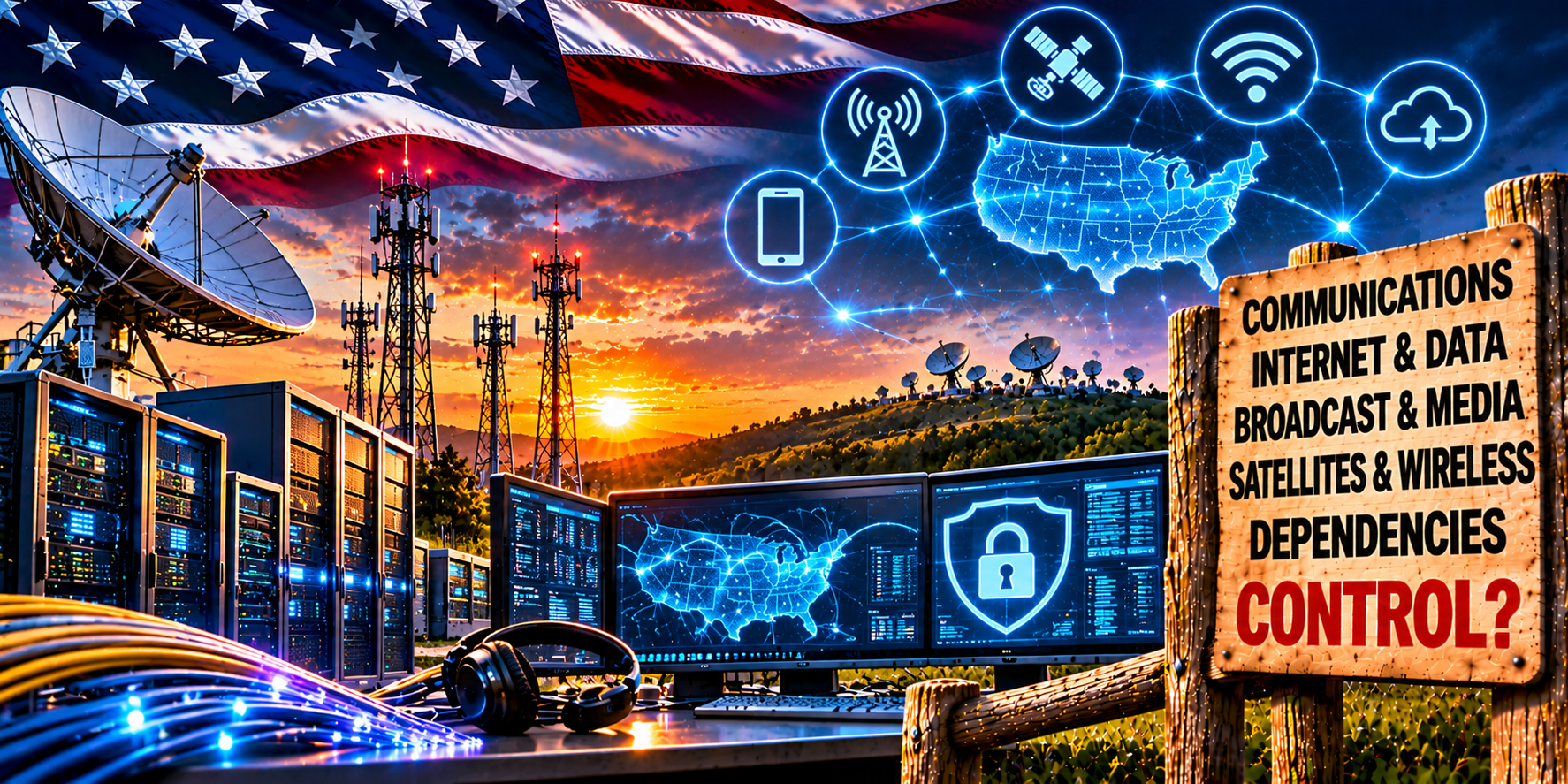
EVIDENCE 009 | NATIONAL CRITICAL INFRASTRUCTURE INVESTIGATION
AMERICA'S
COMMUNICATIONS
FORENSIC AUDIT
Who Controls Our Connected Networks — and What Happens When Communications Fail?
Investigating telecommunications ownership, internet infrastructure, satellites, digital identity, shared providers and the cascading consequences of lost connectivity.
OPEN THE INVESTIGATIONCOMMAND CENTEROWNERSHIP
INFRASTRUCTURE
UNDERSEA CABLES
& CYBERSECURITY
DEPENDENCIES
01 | Documented Incidents
What Happens When America Loses Connectivity?
Communications outages can interrupt emergency calls, payments, healthcare, logistics and public safety. The investigation starts with verified incidents and tests whether their causes were technical, operational, physical or malicious.
AT&T Wireless Outage — February 2024
A nationwide wireless outage affected customers, including some emergency-call capabilities. The FCC investigated and reported a network configuration error during a change process, not a proven cyberattack.
Meta / Facebook Outage — October 2021
A configuration change disrupted global access to Facebook and related services. This illustrates the fragility of routing and service dependencies; it was not established as a hostile intrusion.
Rogers Telecommunications — July 2022
A major Canadian outage disrupted mobile, internet and payment services. An international comparison shows how a network event can propagate across critical services; it is not a U.S. outage.
Salt Typhoon Telecom Intrusions — 2024
U.S. authorities publicly described compromises of telecommunications networks associated with a state-sponsored cyber espionage campaign. Separate confirmed access and exposure from unsupported claims of nationwide service shutdown.
02 | Historical Reconstruction
How America’s Communications Dependencies Evolved
1934Communications Act and FCC
Examine federal communications authority, common-carrier obligations and the historical separation of public regulation from private network ownership.
1984AT& Divestiture
Review the restructuring of the Bell System and its implications for local and long-distance services, interconnection and competition.
1996Telecommunications Act
Trace changes to the statutory competition framework and evaluate measured effects with FCC data rather than assuming a single causal outcome.
2000sBroadband, Mobile and Cloud Dependence
Examine the expansion of broadband, mobile data, content delivery, data centers and common service providers.
2021Meta Routing Outage
Investigate the documented configuration failure, reachability loss and recovery timeline; distinguish routing incidents from security intrusions.
2024AT&T Outage and Telecom Cyber Intrusions
These are separate events with different causes. Compare the FCC’s outage findings with federal cybersecurity advisories on telecom intrusions.
03 | Authority and Ownership
Who Owns the Network — and Who Can Change It?
Asset ownership, operating control, regulatory oversight, routing authority and privileged system access are different kinds of control.
Telecommunications Providers
Map fiber, cellular, tower, backbone and last-mile ownership, including leased infrastructure and wholesale access.
Internet Coordination
Distinguish the roles of autonomous systems, internet exchange points, DNS operators, registries, registrars and standards bodies.
Regulators and Public Agencies
Examine FCC jurisdiction, NTIA programs, state utility responsibilities and public-safety communications authorities.
Cloud, Content and Identity Providers
Identify infrastructure, application, DNS, identity and software dependencies without equating vendor market share with ownership of the entire internet.
04 | Network Architecture
Trace a Message From Device to Destination
Modern communications cross multiple independent systems. The audit maps both the expected path and the alternative paths available after failure.
Access Networks
Cell towers, local fiber, Wi-Fi, fixed wireless, cable and satellite connect users to upstream services.
Backbone, Routing and DNS
Interconnection, BGP routing, DNS resolution, peering, transit and network management influence service reachability.
Satellites and Submarine Cables
International cables, landing stations, ground stations and space-based links provide capacity but may have geographic or supplier chokepoints.
Identity and Security
Authentication, certificates, device management, privileged access, configuration changes and third-party vendors can become shared failure points.
05 | Cross-Sector Cascades
One Network Failure Can Affect Many Essential Services
Emergency Services
Test 911 reachability, public warning systems, dispatch and alternate radio or carrier procedures.
Banking and Commerce
Trace card authorization, ATM connectivity, merchant terminals, payroll and settlement communications.
Healthcare and Utilities
Map remote patient services, hospital records, grid telemetry, water-system controls and safe manual fallback.
Food, Logistics and Education
Examine inventory, transportation scheduling, school communications, digital learning and regional continuity.
06 | SWOT / TOWS
Translate Network Risks Into Preventive Controls
A disciplined audit distinguishes existing strengths from weaknesses requiring evidence and measurement.
SWOT — Identify
Strengths: multiple technologies, established operators and diverse interconnection. Weaknesses to test: shared cloud services, legacy routing controls, single-homed sites and limited visibility. Opportunities: diversity, secure automation and continuity exercises. Threats: cyber intrusions, misconfiguration, cable cuts and natural disasters.
TOWS — Correct
Use operational expertise to test failover; eliminate avoidable single-provider dependencies; harden administrative access; strengthen incident coordination with power, emergency response and financial operators.
Forensic Validation
Correlate configuration records, routing telemetry, alarms, provider statements and independent measurement before attributing an outage.
Accountable Remediation
Assign each exposure an owner, severity, verification test, deadline and evidence of closure.
07 | Resilience Roadmap
Maintain Communications When Primary Networks Fail
The goal is not to eliminate every failure but to prevent avoidable outages and maintain safe essential functions.
Households
Maintain emergency contacts offline, understand wireless emergency limitations, prepare charged devices and identify lawful alternative ways to request help.
Small Businesses
Test backup internet, UPS power, alternate payment and phone procedures, vendor escalation contacts and graceful operation without cloud access.
Network Operators
Use controlled change management, route filtering, secure privileged access, diverse paths, monitored failover, incident exercises and verified restoration plans.
Communities and Policymakers
Evaluate emergency communications interoperability, rural access, critical-facility connectivity, infrastructure resilience and transparent outage reporting.
08 | Evidence Register
Primary Sources and Verification Priorities
Outage investigations, communications regulation and network availability
Communications-sector resilience and telecom cybersecurity advisories
Broadband infrastructure and federal telecommunications policy
Cybersecurity and network resilience frameworks
Public cyber-threat advisories and investigative announcements
Technical standards for internet protocols and routing
INVESTIGATE. VERIFY. CORRECT. REBUILD.
Evidence 009 | America's Communications & Digital Infrastructure Security — FORENSIC AUDIT
RETURN TO FORENSIC AUDIT COMMAND CENTER