
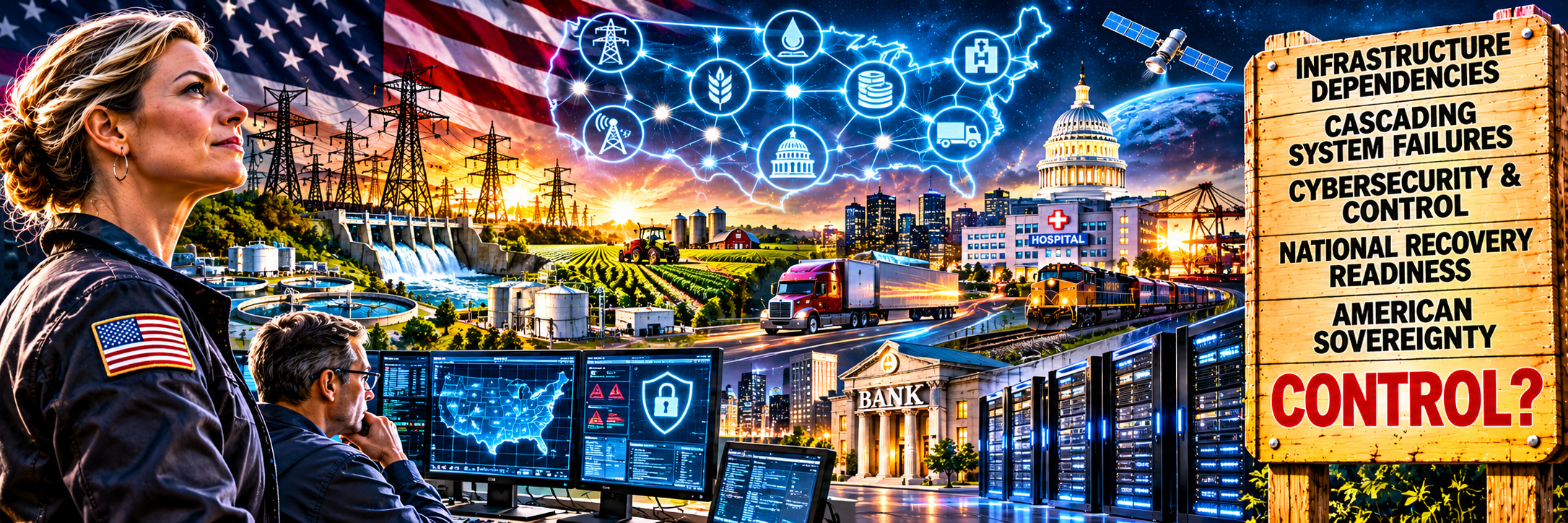
Interconnected American power, water, agriculture, hospitals, transport, finance and cyber operations; wooden plaque concludes CONTROL?

EVIDENCE 024 | NATIONAL CRITICAL INFRASTRUCTURE INVESTIGATION

AMERICA'S
CRITICAL INFRASTRUCTURE
INTERDEPENDENCIES & NATIONAL RESILIENCE

FORENSIC AUDIT: What Happens When America's Essential Systems Fail Together?

Trace documented cascading disruptions, shared dependencies and measurable steps to prevent systemic failure.

OPEN THE INVESTIGATIONCOMMAND CENTER
INFRASTRUCTURE DEPENDENCIES
CASCADING SYSTEM FAILURES
CYBERSECURITY & CONTROL
NATIONAL RECOVERY READINESS
AMERICAN SOVEREIGNTY

01 | FORENSIC AUDIT

The Case: Five Documented System Disruptions

Different initiating events expose the same analytical question: how does failure propagate across essential services?

2003 — Northeast blackout

A transmission-grid disturbance cascaded through interconnected electrical systems, leaving tens of millions without power in the United States and Canada. The joint U.S.–Canada task force documented vegetation management, situational awareness and reliability failures.

2021 — Texas winter storm

Extreme cold and inadequate winterization contributed to widespread generation and fuel-system disruptions. Extended power outages also affected water service, healthcare, transportation and communications.

2021 — Colonial Pipeline ransomware

Following a ransomware attack on business IT systems, the operator proactively halted pipeline operations. Fuel distribution disruption and consumer shortages demonstrated the linkage between digital business systems and physical supply continuity.

2024 — CrowdStrike software update outage

A defective content update affected Windows endpoints globally, disrupting airlines, healthcare and many other organizations. This was a software failure, not evidence of a cyberattack.

2024 — Change Healthcare ransomware

The compromise of a major healthcare transaction intermediary disrupted claims, pharmacy processing and payments, exposing concentrated service-provider dependence.

Audit finding / action: These incidents have different causes. Their common relevance is documented interdependence, not proof of a single coordinated attack. Separate observed impacts from projected nationwide scenarios.

02 | FORENSIC AUDIT

Historical Decisions That Increased Interconnection

Interconnection can improve efficiency and reliability while expanding the blast radius of failures.

1960s–1980s — Large interconnected networks

Regional electric grids, national telecommunications, interstate logistics and centralized industrial production increased capacity but introduced shared infrastructure dependencies.

1990s–2000s — Digital integration

Enterprise networking, internet-connected commerce, automation and globalized sourcing created tighter links among operational, financial and information systems.

2010s — Cloud and platform concentration

Cloud services, managed software, payment networks and consolidated vendors made essential operations more dependent on common technology and identity providers.

2020s — Compound disruptions

Extreme weather, cyber incidents and software failures revealed the importance of regional contingencies, offline operating modes, tested backups and cross-sector coordination.

Audit finding / action: Historical trends vary by sector; do not treat interconnection itself as evidence of malicious design.

03 | FORENSIC AUDIT

Who Owns, Operates and Regulates Critical Systems?

Accountability is distributed among private operators and federal, state, tribal, territorial and local authorities.

Sector ownership and operating authority

Identify asset owners, operators, suppliers, maintenance providers and incident decision-makers. Distinguish regulatory authority from actual operational control.

Federal coordination and standards

CISA coordinates critical-infrastructure security efforts; sector risk management agencies and regulators have different roles. FEMA coordinates emergency management, while NIST publishes voluntary risk-management frameworks.

State and local dependencies

Public utility commissions, water authorities, emergency management offices, hospitals and local governments may hold essential responsibilities but rely on shared vendors and regional infrastructure.

Contracts and concentrated service providers

Review cloud, telecom, fuel, software, logistics and payment contracts for subcontractors, geographic concentration, termination rights, incident notice and restoration commitments.

Audit finding / action: Build an evidence-backed control ledger: asset, owner, operator, regulator, critical vendor, backup, restoration authority and source document.

04 | FORENSIC AUDIT

Dependency Map: How One Failure Becomes Many

Map upstream inputs, operational bottlenecks and second-order impacts rather than assuming every outage causes nationwide collapse.

Electricity → Water → Healthcare

Power is needed for pumping, treatment, refrigeration, communications and medical facilities; backup generation and fuel logistics determine endurance.

Telecom + Timing → Finance + Logistics

Communications and precision timing support dispatch, transactions, network synchronization and supply coordination. Resilience requires alternate links and validated timing holdover.

Fuel + Transportation → Food + Emergency Services

Fuel, rail, roads, ports and warehouses support deliveries, emergency response, agriculture and medical resupply; inventory buffers and alternate routes reduce exposure.

Identity + Cloud + Software → Many Sectors

A shared identity provider, endpoint update or cloud service can simultaneously affect independent organizations. Offline procedures and provider diversification reduce common-mode failure.

Audit finding / action: For every critical service record maximum tolerable downtime, minimum operating level, upstream dependencies, alternate sources, recovery time objective and last tested restoration.

05 | FORENSIC AUDIT

Cybersecurity, Physical Hazards and Cascading Failure Paths

Use forensic discipline to distinguish malicious compromise, accidental technology failures, environmental hazards and deliberate operational shutdowns.

Cyber compromise and OT boundaries

Evaluate remote access, identity controls, segmentation between enterprise IT and industrial control systems, monitoring, patch management and manual safe-state operations.

Shared software and supply-chain risk

Inventory critical software, privileged vendors, update channels and common dependencies. Require staged deployment, rollback plans, vendor assurance and change control.

Physical and environmental exposure

Examine extreme weather, wildfire, flood, seismic events, equipment damage and regional fuel shortages alongside cybersecurity risks.

Evidence collection and incident reconstruction

Preserve event logs, time sources, system configurations, alerts, change tickets, operational records and official statements. Correlate timelines before assigning causation.

Audit finding / action: A cascading outage is not, by itself, evidence of a distributed denial-of-service attack or coordinated sabotage. Assign confidence levels to each hypothesis.

06 | FORENSIC AUDIT

SWOT / TOWS: A National Resilience Assessment

Turn documented vulnerabilities into measurable, accountable corrective action.

STRENGTHS

Diverse infrastructure operators, engineering expertise, emergency management systems, mutual-assistance agreements, domestic innovation and local response capabilities.

WEAKNESSES

Aging assets, deferred maintenance, limited visibility into dependencies, single-source suppliers, fragile vendor integrations and uneven recovery testing.

OPPORTUNITIES

Regional microgrids, backup water and communications, diversified supply chains, secure-by-design procurement, domestic manufacturing and cross-sector exercises.

THREATS

Cyberattacks, extreme weather, equipment failure, software defects, fuel disruptions, labor constraints and correlated failures across shared providers.

Audit finding / action: TOWS: SO—use technical capacity to diversify and modernize; WO—map hidden dependencies and fund tested backups; ST—apply mutual aid and secure operations against compound hazards; WT—eliminate avoidable single points of failure and establish minimum viable service levels.

07 | FORENSIC AUDIT

National Infrastructure Resilience Framework

A phased approach for households, small businesses, infrastructure operators and public authorities.

0–30 Days — Identify the Essentials

Inventory critical services and dependencies. Name owners, emergency contacts, vulnerable populations, essential medicines, backup communications and the minimum functions that must remain available.

30–90 Days — Build and Test Alternatives

Verify offline backups, manual operating procedures, backup power and fuel, alternate suppliers, redundant communications and water continuity. Run a realistic restoration exercise.

90–180 Days — Coordinate Across Sectors

Conduct cross-sector tabletop exercises with utilities, hospitals, businesses, logistics operators and emergency managers. Establish restoration priorities, public communication and mutual aid.

Ongoing — Measure National and Local Readiness

Track restoration-test success, downtime tolerance, alternate-provider coverage, supplier concentration, incident detection time, exercise lessons and closure of corrective actions.

Audit finding / action: Resilience is not isolation: preserve the benefits of interconnection while designing independent fallback capabilities and transparent recovery authority.

08 | FORENSIC AUDIT

Primary Sources and Verification Register

Start with official reports and original incident statements. Verify precise document versions and dates before publishing quantitative claims.

Evidence classification: CONFIRMED = primary-source documented; ANALYSIS = reasoned interpretation; SCENARIO = plausible but unverified future event. Maintain a dated evidence ledger and correct findings when new primary evidence emerges.
EVIDENCE 024 | NATIONAL RESILIENCE CAPSTONE

Twenty-four investigations. One mission: identify verified vulnerabilities, reduce cascading failure risk, and protect essential American services.

RETURN TO THE FORENSIC AUDIT COMMAND CENTER