
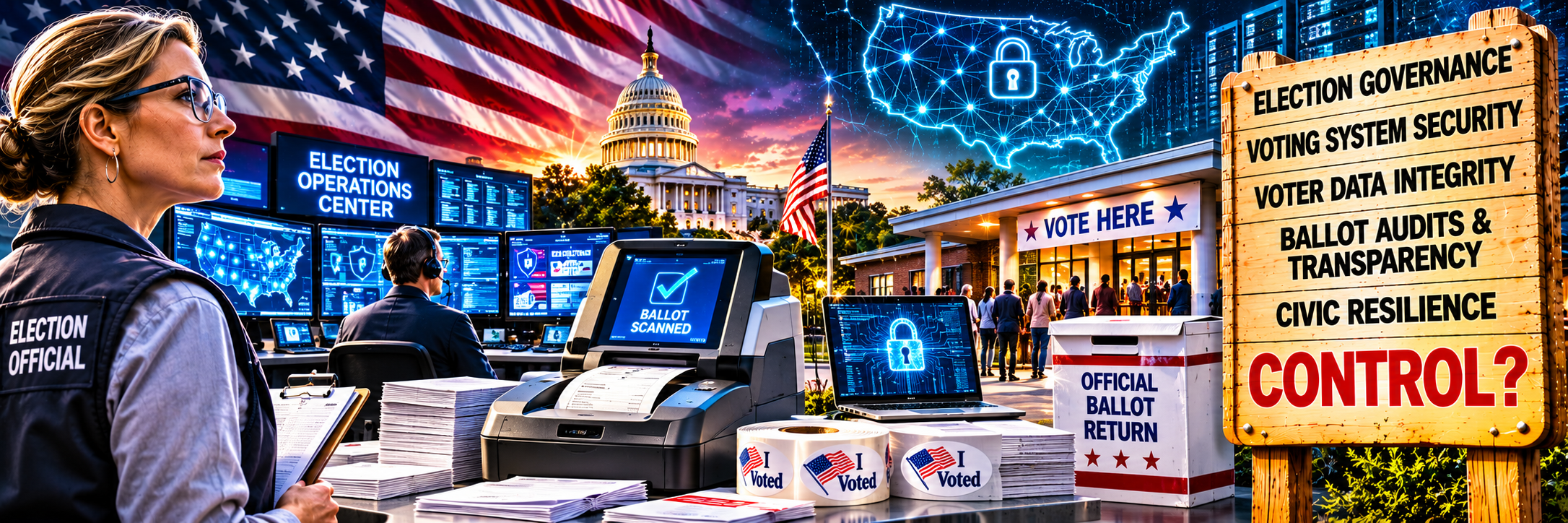
Election official, paper ballots, voting equipment, secure operations center, United States flag, and CONTROL plaque

EVIDENCE 022 | NATIONAL CRITICAL INFRASTRUCTURE INVESTIGATION

AMERICA'S
ELECTION INFRASTRUCTURE,
VOTING SYSTEMS &
CIVIC SECURITY

FORENSIC AUDIT: Who Controls America's Election Infrastructure—and Can Americans Independently Verify That Their Votes Are Accurately Counted?

Trace documented threats, operational safeguards, paper records, audits and accountable recovery.

OPEN THE INVESTIGATIONCOMMAND CENTER
ELECTION GOVERNANCE & OWNERSHIP
VOTING TECHNOLOGY & CYBERSECURITY
VOTER REGISTRATION & ELECTION DATA
BALLOT INTEGRITY, AUDITS & TRANSPARENCY
CIVIC SOVEREIGNTY & RESILIENCE

01 | FORENSIC AUDIT

The Case: Documented Threats, Demonstrated Safeguards

An auditable investigation begins with evidence—not a presumption of either perfect security or proven fraud.

2016 — Election Infrastructure Targeting

Federal investigations documented Russian efforts to target election-related infrastructure, including registration-related systems. The Senate Intelligence Committee described extensive targeting; this is not evidence that vote tallies were changed.

2022 — Voting Equipment Vulnerability Advisory

CISA published an advisory on vulnerabilities affecting certain Dominion ImageCast X configurations. A disclosed vulnerability establishes potential exposure, not proof it was exploited to alter election results.

2020 — Election Security and Verification

Federal and state election officials reported no evidence that voting systems deleted, lost or changed votes in the 2020 election. Review this finding alongside state canvasses, audits, litigation records and their specific scopes.

2024 — Election-Related Threat Activity

Federal authorities documented foreign influence and cyber activity targeting election-related organizations and information channels. Distinguish attacks on campaigns, disinformation and administrative systems from intrusion into vote tabulation.

Evidence standard: Every allegation requires a named jurisdiction, affected system, timestamp, technical evidence, chain of custody, and a finding that distinguishes attempted access, successful compromise, and verified impact.

02 | FORENSIC AUDIT

Timeline: Decisions That Shaped Election Security

The U.S. system is decentralized: authority, equipment and audit rules vary by state and jurisdiction.

2002 — Help America Vote Act

HAVA established federal assistance, minimum election-administration requirements and the Election Assistance Commission. States retain primary responsibility for administering elections.

2017 — Critical Infrastructure Designation

DHS designated election infrastructure a critical infrastructure subsector, enabling additional voluntary coordination, risk assessments and security support.

2018–2024 — Risk-Limiting Audit Expansion

Some states adopted or expanded post-election risk-limiting audits; methods and coverage differ. Distinguish statistical risk-limiting audits from fixed-percentage audits and recounts.

2020s — Layered Election Defenses

Paper records, equipment testing, physical controls, incident reporting, backup procedures, and federal-state information sharing became central security priorities; implementation varies.

03 | FORENSIC AUDIT

Governance, Vendors and Public Accountability

Who owns decisions, who operates the systems, who can inspect them, and who certifies the outcome?

State and Local Election Officials

States set legal frameworks and local jurisdictions typically administer registration, voting, counting and canvassing. Responsibilities must be mapped for the particular state and county.

Federal Support Is Not Federal Control

EAC develops voluntary voting system guidelines and administers a testing/certification program; CISA provides cybersecurity support. Federal agencies do not run every local election.

Private Technology Providers

Vendors may supply ballot scanners, election management systems, pollbooks, registration services or reporting tools. Review contracts, service access, software updates and independent testing.

Oversight and Public Observation

Examine state law governing observers, public records, ballot retention, audit access, procurement transparency, canvassing and legal challenges. Transparency must protect ballot secrecy.

Control test: Publish a jurisdiction-specific responsibility matrix for procurement, configuration, access approval, tabulation, canvass, certification, audit and incident escalation.

04 | FORENSIC AUDIT

Dependencies and Cascading Failure Paths

Election continuity relies on more than voting machines: facilities, people, power, records and communications must all function.

01 | PREPARERegistration, ballots, equipment, poll workers
02 | VOTEAccessible sites, paper records, secure custody
03 | COUNTTabulation, reconciliation, canvass
04 | VERIFYAudits, certification, transparent correction

Power, Facilities and Communications

Outages or physical damage can affect polling places, electronic pollbooks, reporting and logistics. Offline procedures and tested continuity plans reduce dependence on connectivity.

Ballot Production and Logistics

Printing, mail, transport, secure storage and staffing introduce timing and chain-of-custody dependencies. Review contingencies and reconciliation logs.

Registration and Identity Systems

Database errors, outages or unauthorized changes can disrupt check-in. Investigate lawful provisional-ballot and correction procedures.

Unofficial Reporting vs. Certified Results

Election-night websites are information channels; certified results follow canvassing and legal processes. A website outage is not, by itself, evidence that ballots were altered.

05 | FORENSIC AUDIT

Cybersecurity, Physical Security and Evidence Preservation

Evaluate attack surfaces and controls without confusing vulnerability with demonstrated exploitation.

Attack Surfaces

Voter registration portals, email, remote support, electronic pollbooks, election-night reporting, vendor software and facility systems require distinct threat models.

Preventive Controls

Use least privilege, phishing-resistant MFA where supported, hardened endpoints, patch governance, removable-media controls, logging, segmentation and independent configuration review.

Detection and Response

Preserve system images, logs, access histories, ballot records and custody evidence under documented procedures. Establish rapid coordination among election officials and incident responders.

Verification Beyond Software

Voter-verifiable paper records, ballot accounting, chain of custody and meaningful post-election audits provide independent checks that do not depend solely on vendor assurances.

Finding classifications: Confirmed incident • Confirmed vulnerability • Unverified allegation • Plausible scenario • Mitigation tested. Never treat these as interchangeable.

06 | FORENSIC AUDIT

SWOT / TOWS: Translate Findings Into Safeguards

A risk framework that recognizes existing strengths while confronting weaknesses and realistic threats.

STRENGTHS

Decentralized administration, paper-ballot use in many jurisdictions, legal canvassing, testing, audits and established federal-state coordination.

WEAKNESSES

Uneven resources, aging systems, fragmented procurement, inconsistent audit laws, third-party access, limited staffing and variable public understanding.

OPPORTUNITIES

Improve paper-record coverage, risk-limiting audits, transparent procurement, resilient operations, cyber exercises and public-facing audit explanations.

THREATS

Ransomware, insider misuse, physical disruption, vendor compromise, harassment, misinformation and loss of confidence after ambiguous reporting.

TOWS actions: SO—scale proven audit practices; WO—fund and train under-resourced jurisdictions; ST—use paper evidence and independent review to counter technical compromise; WT—remove single points of failure and rehearse manual continuity.

07 | FORENSIC AUDIT

Corrective Action and National Resilience Roadmap

Practical steps for election administrators, oversight bodies, technology vendors and citizens.

First 30 Days — Map and Verify

Inventory systems, contracts, administrator privileges, paper-record workflows, audit requirements and critical dependencies. Document unresolved findings and evidence owners.

30–90 Days — Harden and Exercise

Review MFA, backups, access logs, vendor remote access, ballot custody and physical controls. Conduct tabletop exercises for registration outage, ransomware and misinformation.

90–180 Days — Test Independent Assurance

Validate ballot reconciliation, conduct legally authorized audits, test recovery against offline procedures, publish understandable audit methods and resolve documented gaps.

Ongoing — Sustain Public Accountability

Use recurring external assessments, procurement disclosure, incident reporting, lawful public observation and after-action improvement. Preserve ballot secrecy and accessibility.

Citizen action: Ask your state or county election office how ballots are reconciled, what paper records are retained, what audits are required and how the public can observe lawful processes. Rules differ by jurisdiction.

08 | FORENSIC AUDIT

Primary Sources and Verification Register

Use original advisories, statutes, election-office records and audit reports to confirm jurisdiction-specific findings. Links are research starting points, not proof of a particular allegation.

Audit protocol: Record source title, issuing authority, publication date, affected jurisdiction, claim, evidence, limitations and corrective action. Recheck source links and current state rules before publishing jurisdiction-specific conclusions.
EVIDENCE 022 | ELECTION INFRASTRUCTURE, VOTING SYSTEMS & CIVIC SECURITY

Evidence before conclusions. Independent verification before trust. Resilience before crisis.

RETURN TO COMMAND CENTER