
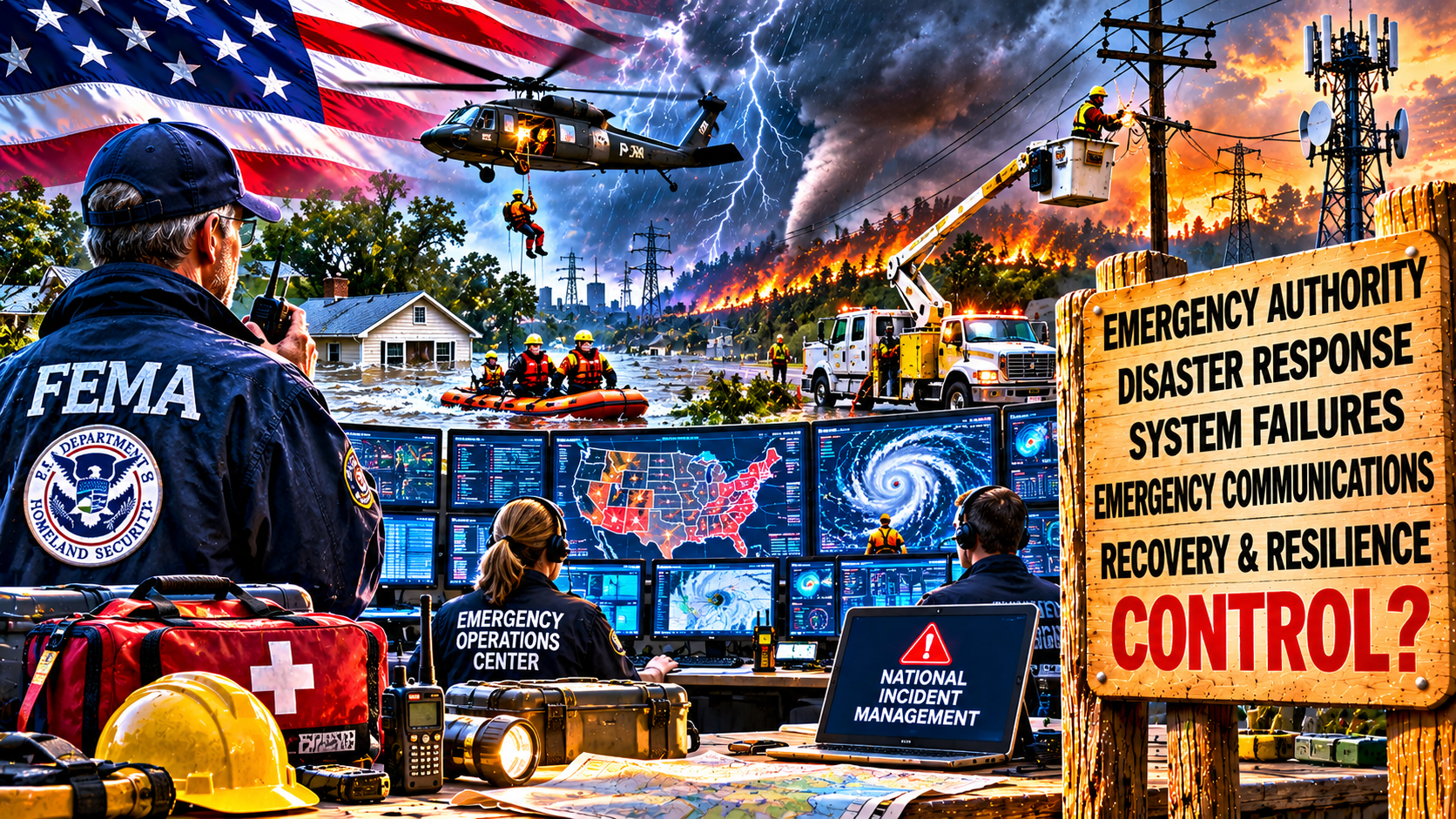
EVIDENCE 013 | NATIONAL CRITICAL INFRASTRUCTURE INVESTIGATION
AMERICA'S
EMERGENCY RESPONSE
& DISASTER RESILIENCE
FORENSIC AUDIT: When Essential Systems Fail, Who Can Restore Them—and How Quickly?
Follow documented disasters, command decisions, communications failures, infrastructure dependencies and measurable recovery—not speculation about intent.
OPEN THE INVESTIGATION COMMAND CENTER& COORDINATION
INFRASTRUCTURE
FAILURES
& CYBERSECURITY
& RESILIENCE
01 | Documented Disasters and Response Breakdowns
What Actually Failed—and What Did Investigators Find?
Three major incidents establish why recovery must be audited as a system, not merely as a disaster declaration.
Hurricane Katrina, 2005
Congressional and federal reviews documented failures in preparedness, communications, coordination and response. Separate levee and flood-protection engineering findings from evacuation and emergency-management findings.
Texas Winter Storm, February 2021
Severe cold triggered widespread electricity outages and cascading water, heating and communications disruptions. FERC/NERC and Texas investigations identify generation, fuel and weatherization vulnerabilities; this was not established as a cyberattack.
Maui Wildfires, August 2023
Official after-action and fire-safety reviews examined evacuation, warning, communications, resource constraints and coordination. Different investigations address distinct questions; do not collapse them into a single unsupported causal claim.
Common Failure Pattern
Warnings, infrastructure readiness, interagency coordination, last-mile alerts, access to essential supplies and recovery capacity must be assessed independently, then as an interconnected system.
02 | Historical Policy and Incident Timeline
How Did America Organize Emergency Management?
The timeline identifies legal frameworks and documented response milestones; it does not imply that every reform solved the failures it addressed.
1979FEMA Established
1988Stafford Act
2001–2004National Preparedness Reorganization
2005–2006Katrina and Post-Katrina Reform
2017Hurricane Maria
2021Texas Winter Storm
2023Maui Wildfires
2024–2026Resilience and Preparedness Updates
03 | Decision Rights and Emergency Accountability
Who Has Authority Before, During and After a Disaster?
Emergency response in the United States is shared across local, tribal, territorial, state and federal authorities. Legal powers, actual resources and operational command are not interchangeable.
Local and Tribal Response
Emergency managers, public safety agencies, utilities and community partners usually carry out initial response under applicable jurisdictional authorities.
States and Governors
States coordinate mutual aid, National Guard resources where authorized, emergency declarations and requests for federal assistance. Specific emergency powers differ by state and law.
Federal Assistance and FEMA
FEMA supports federal coordination and Stafford Act assistance when applicable; other federal agencies retain sector-specific authorities and missions.
Private Operators and Nonprofits
Electric utilities, telecom providers, hospitals, freight operators, volunteer organizations and contractors often control indispensable restoration assets and services.
04 | Cross-Sector Cascade Analysis
When One System Fails, What Fails Next?
A local emergency becomes a systemic crisis when electricity, water, transport, communications, healthcare and supply chains lose the ability to support one another.
Power → Water → Health
Electricity failures can interrupt pumping, water treatment, refrigeration, dialysis, oxygen supply and heating or cooling. Validate real backup endurance rather than relying on nameplate ratings.
Communications → Dispatch → Coordination
Loss of cellular backhaul, radio interoperability, dispatch systems or 911 connectivity can impair alerts and rescue coordination. Confirm redundant paths and failover testing.
Roads and Fuel → Restoration
Flooded routes, bridge closures, fuel shortages and constrained access can delay crews, ambulances, generators and replenishment of essential supplies.
Finance and Digital Identity → Assistance
Payment outages, identity verification failures and unavailable records can obstruct benefits, procurement and family reunification; offline procedures should be defined.
05 | Emergency Communications and Cybersecurity
Can Emergency Operations Function Without Their Primary Networks?
Cybersecurity is a preparedness discipline. A natural-disaster outage must not be attributed to hacking without forensic evidence.
911, Dispatch and Alerting
Maintain alternate dispatch procedures, authenticated alerting channels, tested backup power and coordination with communications carriers and public-safety partners.
Emergency Operations Center
Protect identities with phishing-resistant MFA, least privilege, segmented networks, offline plans and incident logging; exercise command under degraded connectivity.
Utility and Vendor Access
Segment operational technology, validate remote access, retain offline restoration materials and establish emergency vendor-credential revocation procedures.
Public Information Integrity
Publish trusted alert sources, verify changes to evacuation instructions, counter impersonation and provide multilingual, accessible and low-tech notification paths.
06 | SWOT / TOWS For National Preparedness
Turn Findings Into Measurable Preparedness
Strengths and vulnerabilities differ by jurisdiction. Use local hazard assessments, after-action reports, public infrastructure data and tested capabilities.
Strengths
Established mutual aid systems, trained first responders, weather forecasting, emergency medical networks, volunteer organizations and federal assistance mechanisms.
Weaknesses to Validate
Aging utilities, insufficient backup power, fragmented communications, evacuation barriers, supply concentration, staffing gaps and untested continuity plans.
Threats
Severe weather, wildfire, earthquakes, cyber incidents, infrastructure accidents, misinformation and simultaneous multi-region disasters—each assessed separately.
TOWS — Practical Response
Use public-private partnerships to close backup-power gaps, exercise communications failover, diversify supply routes, prioritize vulnerable residents and measure restoration time.
07 | Corrective Actions and Prevention
Build Recovery Capability Before Systems Fail
A recovery plan is not proven until the people, equipment, suppliers, authorities and alternate processes have been exercised together.
Government and Emergency Managers
Maintain updated hazard mitigation and continuity plans; conduct multiagency exercises, mutual aid drills, accessible evacuation planning and public after-action reporting.
Utilities and Infrastructure Operators
Map cross-sector dependencies, maintain fuel and spares, test islanded or backup operations where appropriate, and coordinate restoration priorities with emergency management.
Businesses and Community Institutions
Establish business impact analyses, recovery time objectives, tested offline records, supplier alternatives, communications trees and continuity roles.
Households and Neighborhoods
Build practical emergency supplies, medication and document plans, safe backup-power practices, evacuation routes and neighbor-to-neighbor support aligned with local official guidance.
08 | Primary-Source Evidence Register
Original Reports, Laws and Preparedness Standards
Start with official investigations and primary records. Confirm current versions, findings and jurisdictional applicability before publication.
Federal coordination doctrine and response roles
Incident management and interoperability principles
Federal disaster relief statutory framework
A Failure of Initiative, congressional response review
Joint examination of power and gas system disruptions
Texas utility regulatory and reliability proceedings
Official Maui wildfire investigation and reports
Fire service and disaster preparedness evidence
Public safety communications and interoperability resources
Official weather warnings and historical event data
Federal disaster preparedness, response and recovery oversight
INVESTIGATE. VERIFY. CORRECT. REBUILD.
Evidence 013 | America's Emergency Response & Disaster Resilience — FORENSIC AUDIT
RETURN TO FORENSIC AUDIT COMMAND CENTER