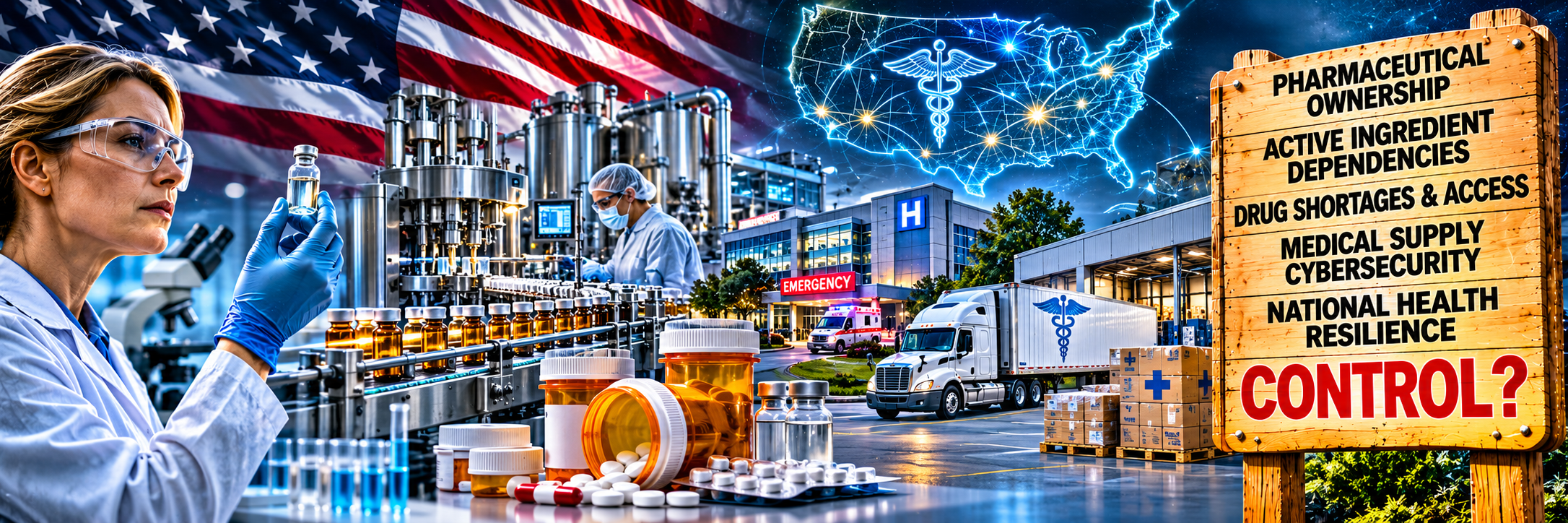
American pharmaceutical manufacturing, scientist, hospital, medical distribution, flag and wooden CONTROL plaque

EVIDENCE 021 | NATIONAL CRITICAL INFRASTRUCTURE INVESTIGATION

AMERICA'S
ESSENTIAL MEDICINES,
PHARMACEUTICALS &
MEDICAL SUPPLY SECURITY

FORENSIC AUDIT: Who Controls America's Essential Medicines—and What Happens When Pharmaceutical Manufacturing and Medical Supply Chains Fail?

Follow the evidence from active ingredients and manufacturing concentration to shortages, distribution cyberattacks and patient continuity.

OPEN THE INVESTIGATIONCOMMAND CENTER
PHARMACEUTICAL MANUFACTURING & OWNERSHIP
ACTIVE INGREDIENTS & FOREIGN DEPENDENCIES
DRUG SHORTAGES & HEALTHCARE CONTINUITY
MEDICAL DISTRIBUTION & CYBERSECURITY
NATIONAL MEDICAL SOVEREIGNTY & RESILIENCE

01 | Documented incidents and consequences

The Case: When Medicine Supply Chains Break

Start with documented disruptions, identify the failure mechanism and separate proven outcomes from plausible but unverified cascade scenarios.

2023 — Cancer Drug Shortages

Shortages of cisplatin and carboplatin affected oncology care. FDA and professional organizations documented supply constraints, while clinicians adjusted treatment planning. Investigate manufacturer quality issues, capacity and alternative suppliers.

2023 — Pfizer Rocky Mount Tornado

A tornado damaged Pfizer’s Rocky Mount, North Carolina, manufacturing facility. Examine the disruption to sterile injectable production, inventory and manufacturer recovery communications.

2024 — Change Healthcare Cyberattack

The ransomware attack disrupted pharmacy claims, payment processing and healthcare transactions. It demonstrates how a technology intermediary can interrupt access and cash flow even when medicines remain physically available.

2024 — Baxter North Cove Hurricane Damage

Hurricane Helene disrupted Baxter’s North Cove, North Carolina, facility, a major producer of IV solutions. Hospitals used conservation and substitution measures while production and distribution recovered.

FORENSIC AUDIT CONTROL: Record dates, source documents, product or service affected, confirmed cause, affected populations, recovery status and any unresolved attribution questions.

02 | Policy and industrial milestones

How the Pharmaceutical Supply System Evolved

Examine the interaction of regulation, patent incentives, manufacturing economics, global trade, procurement and healthcare consolidation.

1938 — Federal Food, Drug, and Cosmetic Act

Established a modern federal framework for medicine safety oversight, later strengthened by amendments and implementing regulations.

1962 — Drug Efficacy Requirements

Kefauver–Harris Amendments expanded premarket evidence requirements and manufacturing oversight after the thalidomide crisis.

1984 — Hatch–Waxman Act

Created pathways and incentives affecting generic drug entry and pharmaceutical innovation; evaluate effects without assuming a single cause for shortages.

2012–2024 — Shortage Reporting and Resilience

FDASIA strengthened certain drug shortage notifications. Later federal reviews and pandemic-era supply chain initiatives highlighted visibility, quality and geographic concentration gaps.

FORENSIC AUDIT CONTROL: Distinguish the date a policy was adopted from the measured effects attributed to it; compare primary statutory and agency records.

03 | Ownership and decision rights

Who Makes, Regulates, Purchases and Distributes Medicines?

Control is distributed among regulators, patent holders, manufacturers, ingredient suppliers, purchasing organizations, distributors and care providers.

FDA and Federal Oversight

FDA regulates drug quality and approvals; ASPR and other agencies support preparedness. FDA does not manufacture all essential medicines or guarantee every product remains in stock.

Manufacturers and Contract Producers

Brand-name and generic manufacturers may operate domestic and overseas facilities or contract production. Map actual product-specific manufacturing and backup capacity.

Purchasing and Distribution

Group purchasing organizations, wholesalers, pharmacy benefit managers, hospitals and pharmacies influence contracting, inventory and patient access. Differentiate ownership from contractual leverage.

Evidence of Concentration

Use FDA shortage notices, inspection records, company filings and GAO analyses to identify verified single-site, single-source or limited-capacity dependencies.

FORENSIC AUDIT CONTROL: Create a product-by-product control map; do not equate foreign manufacture or corporate concentration with evidence of malicious coordination.

04 | Cascading physical and commercial risks

Map the Dependencies Before They Fail

An essential medicine depends on more than its final packaging: raw materials, APIs, sterile production, testing, power, water, transportation and healthcare systems all matter.

Active Pharmaceutical Ingredients (APIs)

Track API and precursor sources, production locations, alternate suppliers, quality requirements and lead times. Country-level totals alone cannot prove dependency for a particular drug.

Sterile Manufacturing Bottlenecks

Injectables require validated sterile lines, trained workers, quality controls and specialized packaging. A damaged plant cannot always be replaced rapidly.

Utilities, Transport and Cold Chain

Power, purified water, gases, packaging, roads, refrigeration and logistics are upstream dependencies with differing recovery times.

Patient and Clinical Consequences

Shortages may lead to conservation, substitutions, delayed treatment or increased workload. Document actual clinical impact and distinguish it from hypothetical worst cases.

FORENSIC AUDIT CONTROL: For each essential product identify single points of failure, stock coverage, validated alternatives, transport constraints and recovery time objectives.

05 | Cybersecurity and operational resilience

Cyberattacks Can Disrupt Access Without Destroying a Factory

Investigate digital chokepoints across manufacturers, wholesalers, pharmacies, claims processors and hospitals.

Identity and Ransomware Exposure

Review privileged access, phishing resistance, endpoint security, segmentation, immutable backups and tested recovery for manufacturing and distribution systems.

Pharmacy Claims and Payments

The Change Healthcare incident illustrates how a concentrated transaction platform can interrupt prescription workflows and payments across otherwise separate organizations.

Manufacturing OT and Quality Systems

Assess production-control networks, laboratory information systems, batch records, vendor remote access and recovery validation. Maintain patient-safety and product-integrity safeguards.

Third-Party and Cloud Dependencies

Inventory critical technology suppliers, interfaces and outage procedures. Demand documented offline or alternative processes for time-sensitive dispensing and clinical care.

FORENSIC AUDIT CONTROL: Separate confirmed incidents, exploitable weaknesses, threat scenarios and attribution; do not imply every shortage was caused by hacking.

06 | SWOT and TOWS assessment

From Exposure to Strategic Options

SWOT describes the current position. TOWS converts evidence into decisions that strengthen supply continuity.

Strengths

FDA oversight, advanced research, domestic manufacturing expertise, clinical networks and established emergency coordination capabilities.

Weaknesses

Limited visibility into some upstream inputs, concentrated sterile capacity, thin inventories, long qualification times and dependence on shared transaction services.

Opportunities

Diversified qualified suppliers, resilient domestic capacity, manufacturing modernization, better shortage signals and tested downtime workflows.

Threats

Natural disasters, quality failures, cyberattacks, transport disruption, geopolitical restrictions and demand spikes.

TOWS — Use Strengths to Reduce Threats

Pair regulatory and clinical expertise with risk-based product prioritization, incident exercises and validated alternate sources.

TOWS — Correct Weaknesses with Opportunity

Invest in supply-chain transparency, procurement incentives for reliability, backup manufacturing, digital segmentation and continuity drills.

FORENSIC AUDIT CONTROL: Score each proposal by measurable shortage reduction, cost, implementation time, patient impact and residual risk.

07 | Corrective action and prevention

A Practical National Medical Resilience Roadmap

Prioritize essential medicines where interruption creates the greatest patient harm, then strengthen both physical and digital continuity.

0–30 Days — Inventory and Triage

Identify critical medicines and IV supplies; document on-hand inventory, actual consumption, supplier contacts, outage protocols and vulnerable patients.

30–90 Days — Test Alternatives

Validate clinically appropriate substitutes, secondary distributors, emergency procurement channels and manual claims or dispensing procedures.

90–180 Days — Reduce Single Points of Failure

Review qualified supplier diversification, reserve policies, site recovery plans, manufacturing cybersecurity and contracts that reward reliable supply.

180–365 Days — Measure Readiness

Run a multi-day medicine shortage and cyber outage exercise. Track time to substitute, inventory coverage, dispensing continuity, restoration and patient outcomes.

FORENSIC AUDIT CONTROL: Publish an accountable owner, milestone, budget, evidence artifact and verification date for every corrective action.

08 | Primary-source research register

Evidence and Official Sources

Use the agencies below to verify incidents, shortage status, legal authority and mitigation guidance. These are research starting points, not a claim that each agency confirms every statement on this page.

Evidence discipline: Update incident-specific records with direct primary reports, publication dates, affected products, and outcomes before making quantitative or attribution claims. Mark unverified claims as questions, not findings.
EVIDENCE 021 | FORENSIC AUDIT

Secure essential medicines. Preserve patient access. Build verifiable national resilience.

RETURN TO COMMAND CENTER