EVIDENCE 006 | NATIONAL CRITICAL INFRASTRUCTURE INVESTIGATION
AMERICA'S
BANKING &
FINANCIAL SECURITY
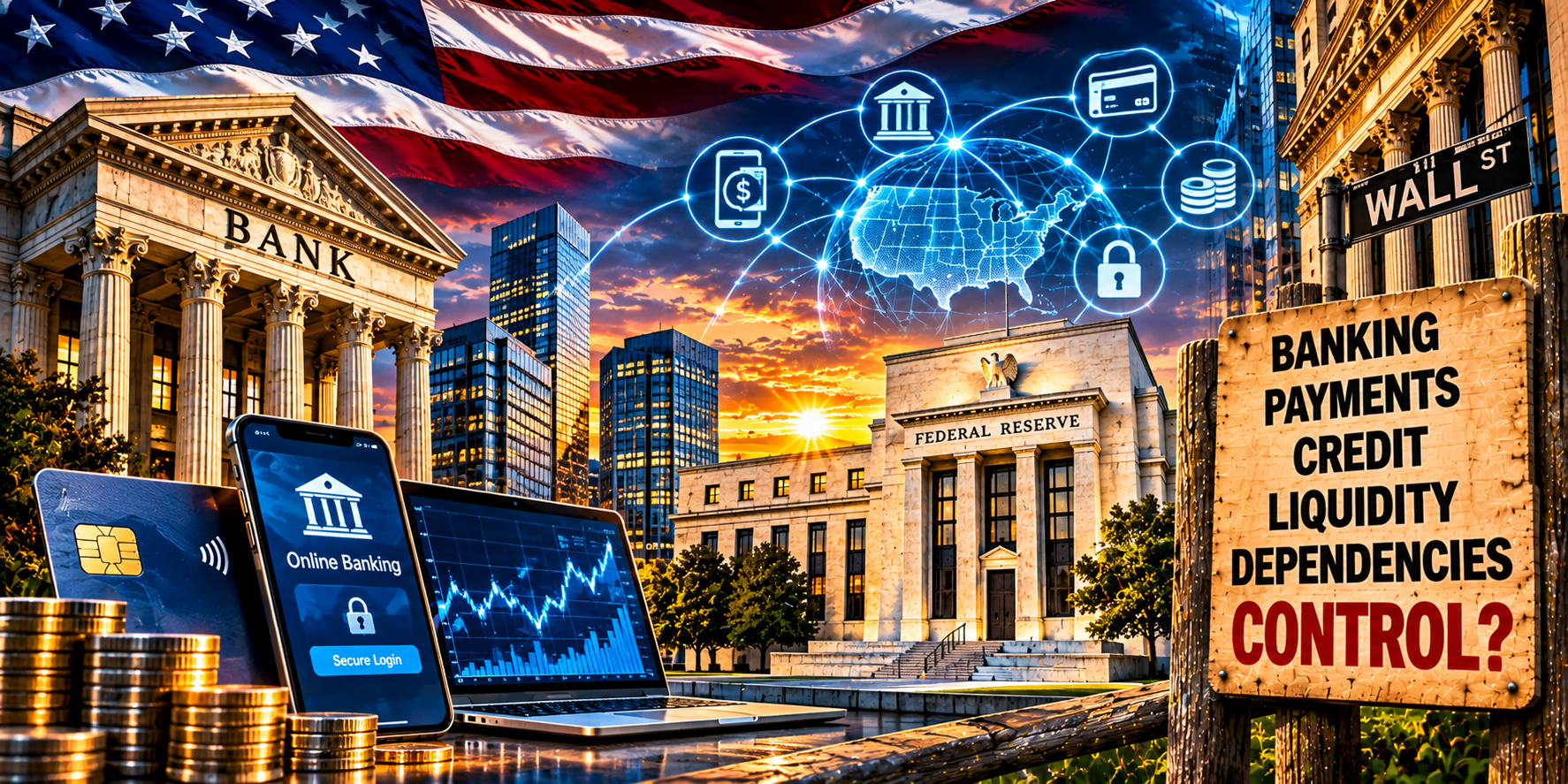
FORENSIC AUDIT: Who Controls the Flow of Money — and What Happens When Financial Infrastructure Fails?
Follow the evidence across banks, payment rails, credit, liquidity, technology providers and the systems that sustain economic activity.
OPEN THE INVESTIGATION COMMAND CENTERGOVERNANCE
SETTLEMENT
LIQUIDITY
DIGITAL IDENTITY
DEPENDENCIES
01 | The Documented Problem
When Financial Infrastructure Fails, Who Can Still Transact?
Banking failures, payment outages, cyber intrusions and liquidity shocks can look similar to customers but arise from different causes. This investigation distinguishes financial solvency, liquidity, operational continuity, cybersecurity and access to essential payments.
Silicon Valley Bank — 2023
Rapid deposit withdrawals and interest-rate risk contributed to the bank's failure. The Federal Reserve published a review of its supervision and regulation. This was not established as a cyberattack.
Bangladesh Bank — 2016
Fraudulent payment instructions involving the SWIFT messaging environment were used in a major theft. Distinguish compromise of a participating institution from compromise of the entire global messaging network.
ICBC Financial Services — 2023
A ransomware incident disrupted operations at the U.S. broker-dealer subsidiary, illustrating third-party and settlement-process dependencies. Assess the documented scope without assuming a nationwide payment failure.
Common Technology Dependencies
What happens when multiple institutions depend on the same cloud, telecommunications, identity, software or transaction-processing provider? Quantify exposure before claiming systemic impact.
02 | Historical Reconstruction
Turning Points in America's Financial Infrastructure
1913Federal Reserve System Established
The Federal Reserve Act created the central banking framework. Investigate its statutory authorities, structure and distinction from commercial bank ownership.
1933FDIC and Deposit Insurance Framework
Federal deposit insurance emerged in response to banking instability. Review coverage limits, resolution responsibilities and what deposit insurance does—and does not—guarantee.
1970sElectronic Payments and ACH Expansion
Automated clearing house systems expanded electronic transfers. Map the operating roles of financial institutions, operators and payment network rules.
1999Financial Services Modernization
The Gramm–Leach–Bliley Act changed the legal framework for financial affiliations and included financial information safeguards. Examine the documented effects rather than assuming one direct causal pathway.
2008Global Financial Crisis
Analyze credit risk, leverage, funding liquidity, interconnections and official post-crisis reforms using Financial Crisis Inquiry Commission and regulatory records.
2016Bangladesh Bank Payment Fraud
Reconstruct the intrusion and fraudulent transfer pathway from documented investigations. Separate messaging-system security from endpoint and participant controls.
2023SVB Failure and FedNow Launch
These are distinct events: SVB was a bank failure; FedNow is a Federal Reserve instant-payment service. Analyze their separate implications for liquidity management and payment availability.
03 | Ownership, Authority and Oversight
Who Owns, Regulates, Operates and Accesses the Financial System?
Commercial and Community Banks
Differentiate publicly traded banks, privately held banks, credit unions and community institutions. Identify deposit liabilities, lending authority and ownership structures.
Central Banking and Supervision
Map the Federal Reserve, FDIC, OCC, state regulators and the CFPB by their actual statutory roles. The Federal Reserve is not equivalent to an individual commercial bank.
Payment Network Operators
Distinguish Fedwire, ACH, FedNow, card networks, clearinghouses and messaging services such as SWIFT. Messaging, clearing and settlement are separate functions.
Technology and Service Providers
Assess core banking platforms, data centers, cloud providers, telecommunications, identity vendors and outsourced processors as potential shared dependencies.
04 | Transaction Pathways
Follow a Payment From Customer Instruction to Final Settlement
Retail and Business Payments
Trace cards, ACH, wires, instant payments, cash access and merchant acquiring. Record which services require continuous internet connectivity and which have alternative processes.
Liquidity and Funding
Examine deposits, withdrawals, collateral, funding concentration and emergency liquidity mechanisms. Operational availability and balance-sheet strength require different tests.
Fraud and Authentication
Review account takeover, business email compromise, fraudulent payment instructions, identity verification and transaction approval controls.
Recovery and Reconciliation
Determine how institutions identify pending payments, avoid duplicate transfers, preserve records and restore settlement following an outage.
05 | Cascading Risk
Financial Services Depend on Much More Than Banks
Power and Communications
Data centers, branches, ATMs, payment terminals, mobile devices and network connections require reliable energy and telecommunications.
Identity, Cloud and Software
Concentrated service providers and shared platforms may create common-mode failures. Verify actual contractual and technical dependencies.
Cybersecurity
Evaluate privileged access, network segmentation, phishing resistance, fraud controls, incident response, immutable backups and third-party assurance.
Economic Continuity
Examine payroll, merchant acceptance, healthcare billing, food distribution, transportation and household access to funds during disruptions.
06 | SWOT / TOWS
Convert Financial Vulnerabilities Into Corrective Engineering
SWOT — FINDINGS TO TEST
- Strengths: Established supervision, diverse payment rails, deposit insurance and institutional continuity planning.
- Weaknesses: Shared service providers, legacy integrations, fraud exposure and funding concentration.
- Opportunities: Resilient payment design, stronger identity controls, vendor transparency and cross-sector exercises.
- Threats: Cybercrime, operational outages, rapid withdrawals, infrastructure failures and financial contagion.
TOWS — ACTIONABLE RESPONSE
- Strength + Opportunity: Use existing oversight and payment diversity to test alternate transaction paths.
- Weakness + Opportunity: Reduce single-provider exposure and exercise offline or deferred processes.
- Strength + Threat: Coordinate financial incident exercises with energy and telecommunications operators.
- Weakness + Threat: Prioritize critical vendor failures, privileged access and liquidity stress testing.
07 | Resilience Roadmap
Keep Households and Businesses Functioning During Financial Disruption
Households
Maintain access to multiple lawful payment methods where practical, enable strong account authentication, keep verified bank contact information and understand applicable deposit-insurance limits.
Small Businesses
Document payroll and merchant payment dependencies, establish alternative processing procedures, verify payment changes out of band and test continuity for multi-day outages.
Financial Institutions
Test liquidity and operational continuity separately, inventory critical vendors, protect payment authorization, exercise reconciliation and measure restoration objectives.
Communities and Policymakers
Assess local cash access, merchant continuity, vulnerable populations and the systemic effect of concentrated technology providers using published evidence.
08 | Primary-Source Evidence Register
Official Records and Verification Priorities
Bank failures, deposit insurance and banking statistics
National bank supervision and risk guidance
Financial stability reports and interagency oversight
Examination guidance and technology risk resources
Critical infrastructure and cyber incident guidance
Fedwire, FedACH and FedNow service information
INVESTIGATE. VERIFY. CORRECT. REBUILD.
Evidence 006 | America's Banking & Financial System Security — FORENSIC AUDIT
RETURN TO FORENSIC AUDIT COMMAND CENTER