
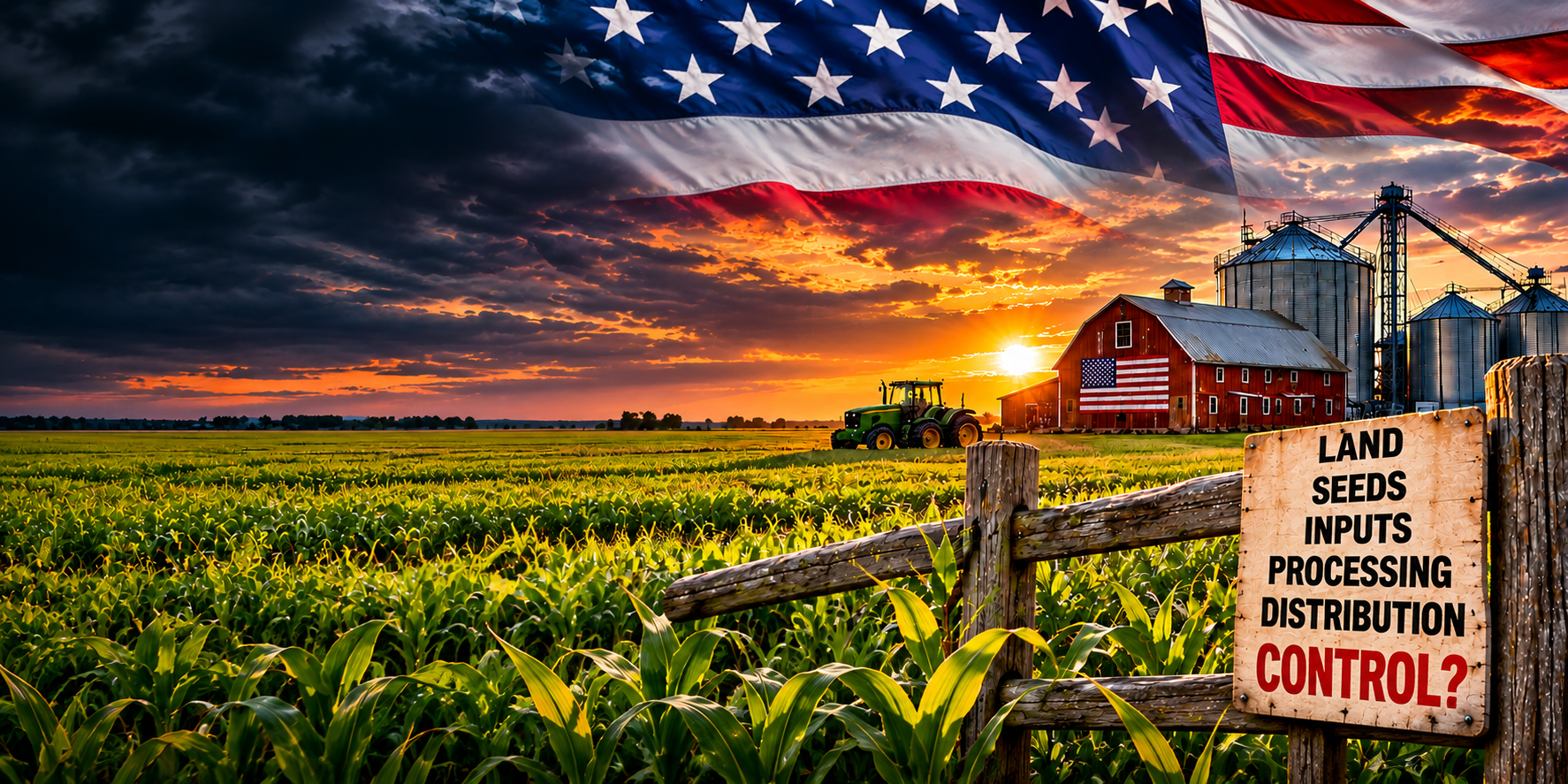
Evidence 003 | National Infrastructure Investigation
WHO CONTROLS
AMERICA'S
FOOD SUPPLY?
FORENSIC AUDIT: Ownership, Consolidation & Critical Dependencies
Follow the evidence from American farmland and family farms to seeds, agricultural inputs, meat processing, foreign investment, and the systems that determine who can produce and distribute food.
OPEN THE INVESTIGATION COMMAND CENTEROWNERSHIP
CONTROL
PROCESSING
DEPENDENCIES
VULNERABILITIES
01 | Open Investigation
Who Owns the Land? Who Controls the Supply?
America's food system involves overlapping forms of power: land title, operating leases, seed licensing, input supply, processing capacity, transportation access, retail purchasing, and financial leverage. This audit investigates each separately before assessing their combined effect on resilience.
Who holds legal title?
Identify farmland ownership categories, foreign-held agricultural land reported under federal disclosure requirements, and changes in ownership over time. Ownership is not equivalent to operational control.
Who sets the terms?
Investigate leases, seed contracts, input availability, processor access, buyer concentration, logistics, and financing arrangements that affect producers' choices and bargaining power.
02 | Historical Reconstruction
How Did the Structure Change?
The following records establish investigative milestones. They do not, on their own, establish a single cause for today's ownership or market structure.
1978Foreign Agricultural Land Disclosure
The Agricultural Foreign Investment Disclosure Act (AFIDA) established reporting requirements for foreign persons holding interests in U.S. agricultural land. Annual USDA reports provide an important but bounded evidence source.
USDA Farm Service Agency — AFIDA
Investigate: What land is reported, how is it classified, and how do ownership shares compare with total U.S. agricultural acreage?
1980sFarm Financial Stress and Structural Change
Use USDA Economic Research Service historical data and agricultural census records to reconstruct farm financial stress, farm numbers, size distribution, and changes in operator demographics. Avoid attributing all change to a single policy or event.
1990sSeed Technology, Intellectual Property, and Licensing
Review the commercialization of biotechnology traits, seed licensing arrangements, patent protections, and the effects of mergers and market concentration on farmer choice. Separate legal protections, documented pricing trends, and demonstrated competition effects.
2000s+Processing and Supply-Chain Concentration
Compare historical concentration measures with plant-level and regional processing capacity. National market share alone does not reveal all local bottlenecks; geography, capacity, access, and disruption recovery matter.
2020sResilience, Succession, and Foreign Holdings
Use the 2022 Census of Agriculture, USDA AFIDA annual reports, and current industry records to test trends in producer age, farm structure, ownership, and critical supply dependencies. Report the year and denominator for every percentage.
03 | Land and Farm Ownership
Follow the Land Records
A defensible ownership investigation must distinguish the owner, the operator, the beneficial owner where lawfully ascertainable, and the person or entity making production decisions.
Family Farms and Succession
Measure farm counts, acreage by farm size, producer age, succession pressures, and access to land. Compare census years consistently, noting changes in definitions and methodology.
Foreign-Held Agricultural Land
Use AFIDA-reported acreage, categories, and country attribution. Compare reported holdings with the appropriate USDA acreage denominator; do not equate reported ownership with control of the food supply.
Corporate and Institutional Ownership
Investigate ownership vehicles, investment funds, operating leases, and financing structures using records that can substantiate the specific claims.
Local and Regional Capacity
Evaluate whether producers can access affordable land, water, equipment, inputs, processing, and markets in their own region.
04 | Economic and Operational Control
Ownership Is Only One Layer
Seeds, Fertilizer, and Chemicals
Measure supplier concentration, licensing restrictions, switching costs, import reliance, and regional availability. Document specific product markets rather than treating all agricultural inputs as one market.
Meat Processing
Examine processor market shares, plant locations, slaughter capacity, contract structures, regional alternatives, and the effect of disruptions on ranchers and consumers.
Transportation and Cold Chains
Trace dependence on fuel, electricity, refrigeration, trucking, rail, warehouses, dispatch software, and payment systems.
Purchasing and Market Access
Study bargaining power, contracts, retailer procurement, access to distribution channels, and barriers to smaller producers.
05 | Critical Dependencies
Where Could a Failure Cascade?
The purpose is to identify and test realistic single points of failure—not to assume that a concentrated system is necessarily malicious or that every disruption is coordinated.
Processing Bottlenecks
Assess regional plant capacity, alternate facilities, transport distance, workforce availability, and recovery time following an outage or closure.
Connected Agriculture
Map farm equipment services, industrial controls, cloud platforms, inventory systems, logistics, and electronic payments. Identify access controls and manual fallback capability.
Single-Source Inputs
Determine which inputs lack practical substitutes, how long inventories last, and whether alternative suppliers are qualified and reachable.
Foreign and Domestic Exposure
Evaluate dependencies by product, country, supplier, and geographic bottleneck. Foreign ownership, imports, and operational dependencies must be measured separately.
06 | Strategic Assessment
SWOT Analysis and TOWS Response
Strengths
- Extensive domestic agricultural resources and producer expertise.
- Established research, transport, processing, and distribution systems.
- Available USDA data for examining many historical trends.
Weaknesses to Test
- Concentrated local processing access.
- High switching costs for critical inputs.
- Farm succession and regional capacity gaps.
Opportunities
- Expand regional processing and supplier options.
- Improve transparency in land and market data.
- Support succession planning, cybersecurity, and continuity testing.
Threats to Model
- Severe weather, disease, power loss, and cyber incidents.
- Transportation interruptions and import disruptions.
- Loss of a critical processor or input supplier.
07 | Corrective Action
Restore Choice. Build Redundancy. Protect Production.
Preserve Operational Options
Map essential inputs, evaluate contract constraints, identify alternate buyers and processors, and plan for succession and business continuity.
Strengthen Regional Capacity
Assess food production, local processing, storage, transportation, and emergency distribution before investing in gaps.
Engineer Resilience
Test backup power, secure connected systems, verify supplier alternatives, and measure recovery time for critical operations.
Require Transparent Evidence
Use verified ownership, competition, and infrastructure data to evaluate lawful reforms and measurable outcomes.
08 | Evidence Register
Primary Records for Verification
These are research entry points for the investigation. Each numerical finding added later must cite the specific report, year, table, and denominator used.
Open USDA AFIDA information and reports
Open census reports and tables
Open farm economics data
Open biotechnology research
Open processing and marketing research
EVIDENCE 003 | WHO CONTROLS AMERICA'S FOOD SUPPLY?
INVESTIGATE. VERIFY. CORRECT. REBUILD.
RETURN TO FORENSIC AUDIT COMMAND CENTER