
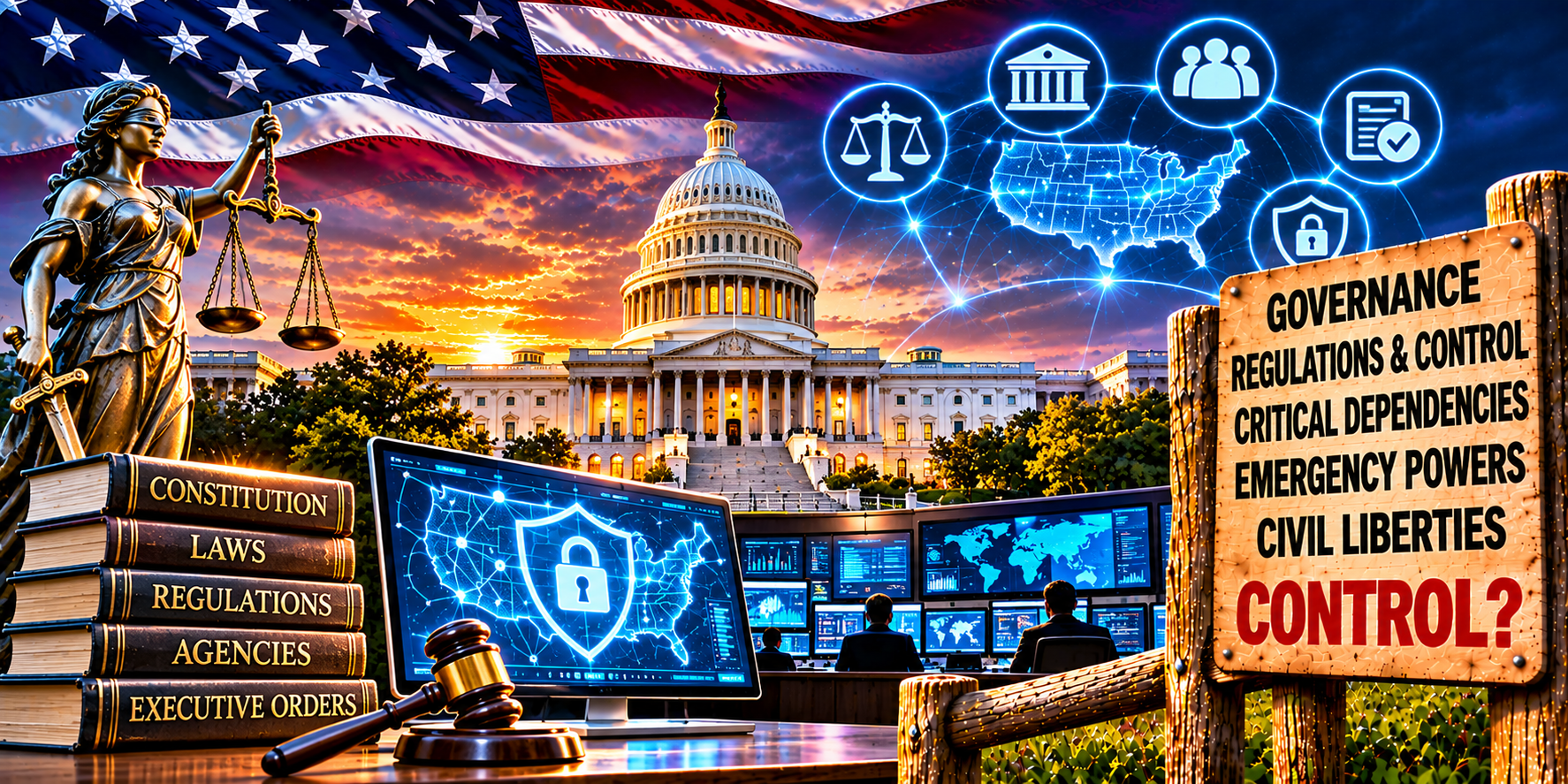
EVIDENCE 011 | NATIONAL CRITICAL INFRASTRUCTURE INVESTIGATION
AMERICA'S
GOVERNMENT &
INFRASTRUCTURE GOVERNANCE
FORENSIC AUDIT: Who Has the Authority to Govern, Regulate and Direct America's Essential Systems?
Trace constitutional powers, statutory authority, regulatory oversight, emergency declarations, operational dependencies and cybersecurity accountability—with documented evidence and clear limits on every claim.
OPEN THE INVESTIGATION COMMAND CENTERAUTHORITY
EXECUTIVE ORDERS
OVERSIGHT
& CIVIL LIBERTIES
& ACCOUNTABILITY
01 | Documented Government-System Failures
When Government Systems Fail, Who Is Accountable?
Begin with verified service disruptions and security incidents, identify the responsible entities, reconstruct root causes and assess the effects on the public.
U.S. Office of Personnel Management — 2015
OPM disclosed cyber intrusions affecting federal personnel and background-investigation records. Review the official investigative findings, control failures and reforms.
SolarWinds Supply-Chain Compromise — 2020
A software supply-chain compromise affected multiple organizations, including federal agencies. Identify what was confirmed at each agency and distinguish access from demonstrated data theft or operational disruption.
Colonial Pipeline — 2021
A ransomware attack against a private pipeline operator led to a precautionary shutdown of pipeline operations. Analyze the public-private boundary, energy-sector consequences and emergency coordination; this was not a federal government network breach.
Federal Government Technology Dependencies
Investigate shared identity systems, cloud vendors, telecom services, contractors and legacy applications as possible common-mode failure points; do not claim a specific vulnerability without evidence.
02 | Historical and Legal Reconstruction
How Authority and Oversight Evolved
1787–89U.S. Constitution and Federal Structure
Review enumerated federal powers, separation of powers, checks and balances, federalism and the rights protected by the Constitution. Distinguish legal text from later judicial interpretation.
Congress — Constitution Annotated1946Administrative Procedure Act
Establishes important procedures for federal agency rulemaking and judicial review. Investigate when notice-and-comment rules apply and where statutory exceptions exist.
1976National Emergencies Act
Provides a framework for declaring and administering certain national emergencies. An emergency declaration does not by itself confer unlimited authority; identify the separate statutory power invoked.
1988Stafford Act Framework
Federal disaster assistance operates within defined legal procedures and federal-state relationships. Distinguish disaster declarations from other emergency authorities.
2002Federal Information Security Modernization Framework Begins
FISMA established a framework for federal information security, subsequently amended in 2014. Investigate agency responsibilities, oversight and effectiveness.
2018CISA Established
The Cybersecurity and Infrastructure Security Agency was established within DHS. Examine its statutory mission, sector coordination and the distinction between advisory coordination and direct operational control.
2021Executive Order 14028 — Federal Cybersecurity
The order directed federal cybersecurity improvements. Evaluate implementation and subsequent policy changes using the order, agency directives and oversight reports.
03 | Constitutional and Statutory Authority
Who Can Lawfully Make Which Decisions?
For every decision, identify the exact power, institution, statute, regulation, jurisdiction, review process and affected rights.
Congress
Legislates within constitutional limits, appropriates federal funds and conducts oversight. Investigate delegations to executive agencies and the limits of those delegations.
Executive Branch and Agencies
Executes statutes, administers programs and issues regulations under delegated authority. Executive orders must operate within constitutional and statutory limits.
States, Localities and Tribal Governments
Exercise distinct governmental powers and responsibilities. Infrastructure rules, emergency responses and public services often depend on overlapping jurisdictions.
Courts and Public Accountability
Judicial review, public records, inspectors general, legislative oversight and procedural rights provide mechanisms for contesting and examining government actions.
04 | Governance Dependency Map
Where Do Public Authority and Essential Infrastructure Intersect?
Government agencies regulate, fund, operate or coordinate different pieces of critical infrastructure; private operators may control the physical assets.
Energy, Water and Transportation
Map the specific roles of federal and state regulators, public utilities, local authorities, private owners and emergency managers.
Communications and Digital Services
Trace telecom operators, cloud providers, public safety networks, procurement agreements, identity services and the continuity of essential government operations.
Financial, Healthcare and Food Systems
Identify the legal and operational boundaries among oversight bodies, market participants, healthcare providers, supply-chain operators and emergency programs.
Interagency and Public-Private Coordination
Test decision rights, information-sharing pathways, restoration authority and accountability when multiple sectors fail at once.
05 | Government Cybersecurity and Oversight
Can Public Services Continue Through a Cyber Incident?
Assess federal, state and local systems against actual legal obligations and technical controls; no single standard automatically applies to every agency.
Identity, Privilege and Zero Trust
Inventory users, contractors and service accounts; apply phishing-resistant authentication, least privilege, segmentation and monitored administrative access.
Software and Contractor Risk
Review acquisition controls, supplier attestations, software inventories, update integrity, incident-notification clauses and shared-service dependencies.
Evidence Preservation and Recovery
Test immutable logs, chain of custody, backup restoration, incident reporting, continuity plans and independent review of corrective actions.
Public Transparency and Rights
Balance incident disclosure with protection of sensitive systems and personal information. Evaluate oversight findings and lawful avenues for redress.
06 | SWOT / TOWS
Turn Governance Gaps Into Verifiable Corrective Actions
Use documented evidence to evaluate strengths and weaknesses rather than treating every concentration of authority as proof of misconduct.
Strengths
Constitutional checks, statutory procedures, independent courts, inspectors general, sector expertise and established emergency management structures.
Weaknesses to Verify
Unclear cross-agency ownership, legacy systems, inconsistent vendor oversight, slow remediation and opaque interdependencies.
Opportunities
Transparent control registers, better public reporting, cross-sector exercises, procurement modernization and tested continuity processes.
TOWS — Correct and Prevent
Pair oversight powers with published risk closure; assign interagency owners; test alternate services; preserve lawful review and challenge processes; measure improvement.
07 | Corrective Action and Prevention
Strengthen Resilience Without Sacrificing Constitutional Accountability
The goal is practical, lawful resilience at the household, local, state and national levels.
Citizens and Households
Know authoritative emergency channels, keep essential records accessible offline where safe, and use lawful public-comment and records-request processes to scrutinize decisions.
Small Businesses
Map regulatory and service dependencies, document essential permits and payment processes, maintain tested continuity plans and verify official communications.
Agencies and Infrastructure Operators
Assign decision rights, maintain asset and supplier inventories, harden access, exercise continuity, publish appropriate performance measures and validate remediation.
Legislatures and Oversight Bodies
Require clear statutory authority, proportionality, sunset and review mechanisms where applicable, independent audits and transparent follow-through on material findings.
08 | Primary-Source Evidence Register
Constitutional Text, Official Records and Verification Priorities
Constitutional provisions and judicial interpretation
Codified federal statutes and legal authority
Executive orders, proposed rules, final rules and notices
Federal IT, cybersecurity and high-risk program oversight
Federal management, budget and cybersecurity policy resources
Critical infrastructure coordination and cybersecurity guidance
Emergency management and disaster assistance framework
Cybersecurity Risk Management Framework
Federal personnel-system notices and cybersecurity resources
INVESTIGATE. VERIFY. CORRECT. REBUILD.
Evidence 011 | America's Government & Infrastructure Governance — FORENSIC AUDIT
RETURN TO FORENSIC AUDIT COMMAND CENTER