
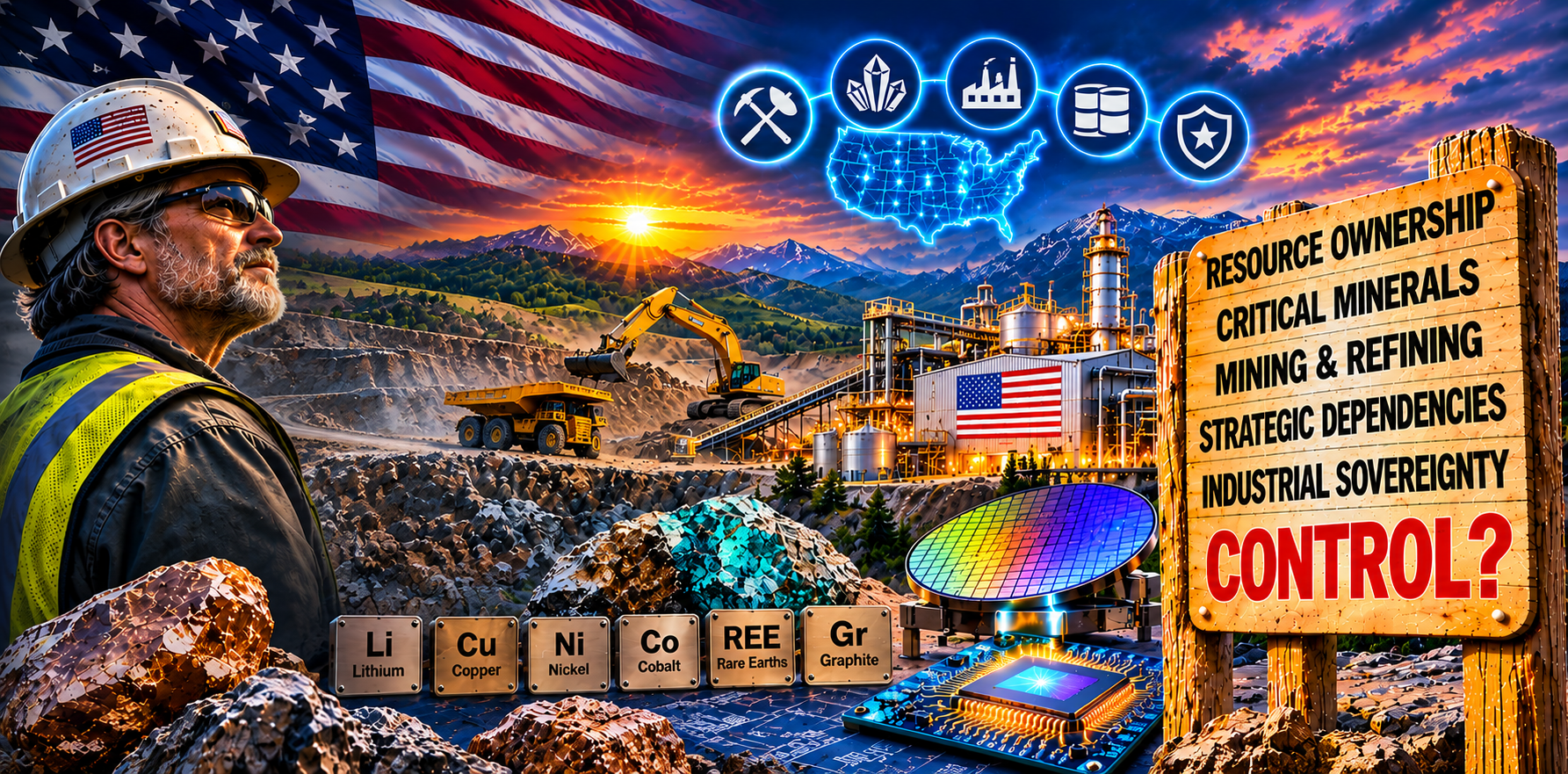
EVIDENCE 018 | NATIONAL CRITICAL INFRASTRUCTURE INVESTIGATION
AMERICA'S
NATURAL RESOURCES
& INDUSTRIAL SOVEREIGNTY
FORENSIC AUDIT: Who Controls America's Critical Minerals?
Follow ownership, extraction, processing, industrial supply chains and national resilience.
OPEN THE INVESTIGATIONCOMMAND CENTER01 | Documented Industrial Supply Disruptions
When Mineral Processing Becomes a National Dependency
A mineral deposit is not a finished industrial input. Follow documented export restrictions and supply-chain interruptions before assigning causes or intent.
2023 China Gallium and Germanium Export Controls
China introduced export licensing requirements for gallium- and germanium-related products in 2023. Investigate the published measures, affected materials and actual commercial consequences rather than treating every license as a complete export ban.
2024 Chinese Restrictions on Selected Critical Minerals
China announced further export restrictions involving certain dual-use materials in December 2024. Compare the exact product classifications, destinations and enforcement rules with subsequent policy changes.
2021–2022 Magnesium Supply Pressure
European magnesium buyers experienced supply and price concerns linked to Chinese production curtailments and energy conditions. Trace which sectors depended on imported primary magnesium and which substitutes were technically feasible.
U.S. Geological Survey Mineral Commodity Summaries
USGS annual summaries document production, import reliance and commodity-specific supply chains. Use the current edition and distinguish net import reliance from an absolute absence of domestic resources.
02 | Historical Decisions and Milestones
How Did the Resource Supply Chain Evolve?
A chronological review separates mining availability, refining capability, industrial policy and geopolitical exposure.
1970s–1980s | Industrial and Environmental Change
Energy costs, environmental rules, global competition and investment decisions influenced U.S. extractive and processing industries differently by commodity. Avoid attributing all change to one law.
1990s–2000s | Global Processing Concentration
Over time, parts of rare-earth separation and downstream manufacturing became concentrated abroad. Compare USGS historical series and commodity-specific processing evidence.
2017–2022 | Federal Critical-Mineral Policy
Executive and statutory initiatives expanded federal attention to critical minerals, supply-chain assessments and domestic processing investment; review exact mandates and funding.
2023–2026 | Export Controls and Supply-Chain Investment
Export restrictions, domestic processing projects, recycling initiatives and allied-country partnerships altered risk assessments. Verify current project status before counting announced facilities as operational.
03 | Ownership, Permits and Decision Rights
Who Owns the Resource—and Who Can Produce It?
Subsurface ownership, surface access, permitting and downstream processing can belong to different parties.
Federal, State, Tribal and Private Mineral Estates
Determine the mineral estate and applicable jurisdiction. Federal leases, state trust lands, tribal rights and private deeds have distinct procedures and protections.
Permits, Water and Environmental Safeguards
Review applicable federal and state approvals, environmental assessment, water allocation, reclamation bonding and community consultation. These govern feasibility but do not establish beneficial ownership.
Beneficial Ownership and Commercial Contracts
Examine corporate disclosures, joint ventures, off-take agreements, financing covenants and downstream sales. Do not equate a foreign customer with ownership of a mine.
Strategic Procurement and Public Accountability
Assess federal purchasing, defense priorities, stockpile authority and agency oversight while distinguishing public policy from private commercial operation.
04 | Industrial Bottlenecks and Cascades
From Ore to Semiconductor, Grid or Defense System
A domestic mine cannot alone guarantee domestic industrial independence.
Mining and Beneficiation
Evaluate ore quality, mine life, infrastructure, labor, water, energy and beneficiation capacity. A resource estimate is not a proven reserve or a production forecast.
Separation, Refining and Conversion
Map metallurgical and chemical processing steps, yields, hazardous-waste management and specialized plant capacity; identify countries at each transformation stage.
Manufacturing and Qualification
Trace magnets, batteries, alloys, catalysts, wafers and defense components; qualification standards and replacement lead times can be critical bottlenecks.
Logistics, Energy and Water
Assess rail, ports, power, chemicals, water, OT systems and single-site processing dependencies; model consequences of losing one critical input.
05 | Cybersecurity and Industrial Integrity
Can Mines, Refineries and Supply Chains Resist Disruption?
Physical resource security now depends on secure industrial control and trustworthy digital records.
Operational Technology and Safety
Inventory SCADA, PLCs, remote maintenance, instrumentation and safety systems. Segment OT networks, limit privileged access and test safe manual fallback.
Supply-Chain and Procurement Fraud
Verify vendor bank changes, assay certificates, shipment provenance and procurement records; use dual approvals and immutable transaction evidence.
Geological and Ownership Data Integrity
Protect exploration records, assay results, mineral-rights documents, permitting systems and proprietary process parameters from manipulation or ransomware.
Incident Response and Continuity
Maintain offline backups, alternate communications, spare critical controllers, safe shutdown procedures and recovery exercises with suppliers.
06 | SWOT / TOWS Assessment
Where Can America Regain Industrial Resilience?
Translate documented advantages and constraints into measurable decisions.
Strengths
Significant geological resources, research universities, engineering capability, manufacturing customers, allied relationships and recycling innovation.
Weaknesses to Verify
Commodity-specific processing gaps, high capital requirements, lengthy qualification, limited workforce, concentrated off-take and insufficient visibility into subcontractors.
Opportunities
Domestic refining, allied-country processing, recycling, material substitution, secure industrial automation and transparent permitting milestones.
Threats and TOWS Responses
Trade restrictions, geopolitical shocks, commodity price cycles, cyber incidents and project delays. Diversify qualified sources and fund resilient processing, not only extraction.
07 | Corrective Measures and Prevention
Build Industrial Capacity That Survives Disruption
The objective is practical continuity—not merely announcing new mines.
Households and Communities
Review local mineral and water-rights rules, demand clear project impact disclosures and support transparent workforce training and reclamation accountability.
Small and Medium Manufacturers
Map critical material grades and single suppliers, validate alternate components, protect supplier payments and retain documented emergency inventories.
Industrial Operators
Create mine-to-product provenance maps, qualify multiple refiners, segment OT, test recovery, maintain safe shutdown capability and verify environmental compliance.
Government and Public Procurement
Use current USGS data, transparent contract terms, independent audits, measurable domestic processing goals and strategic stockpile exercises consistent with law.
08 | Primary-Source Evidence Register
Verify Each Claim Against Primary Records
These official research and regulatory sources are starting points. Confirm current editions, restrictions, projects and commodity data before publication of quantitative conclusions.
INVESTIGATE. VERIFY. CORRECT. REBUILD.
Evidence 018 | America's Natural Resources, Minerals & Industrial Sovereignty — FORENSIC AUDIT
RETURN TO FORENSIC AUDIT COMMAND CENTER