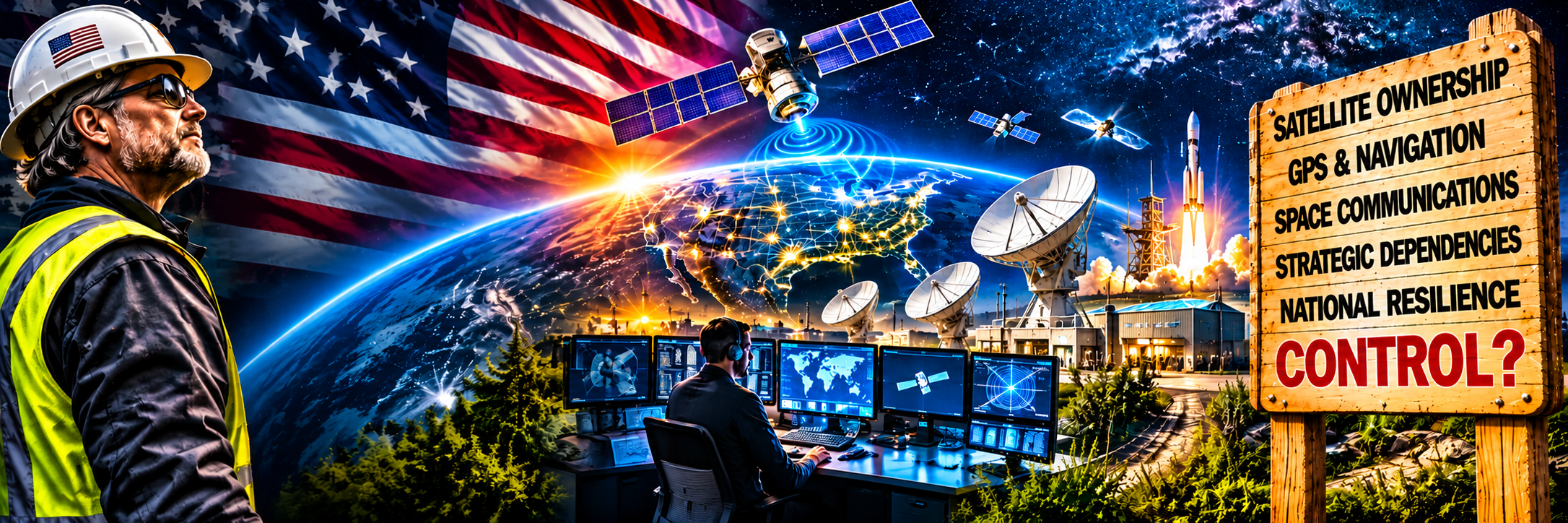
American flag, satellites, Earth, rocket launch, ground stations and wooden plaque listing five space infrastructure dependencies and red CONTROL question

EVIDENCE 020 | NATIONAL CRITICAL INFRASTRUCTURE INVESTIGATION

AMERICA'S
SPACE, SATELLITE &
NAVIGATION
INFRASTRUCTURE

FORENSIC AUDIT: Who Controls America's Space-Based Infrastructure—and What Happens When Satellites, GPS and Critical Communications Become Unavailable?

Trace ownership, precision timing, ground-system security, foreign dependencies and the cascading effects of space-service disruption.

OPEN THE INVESTIGATIONCOMMAND CENTER
SATELLITE OWNERSHIP & GOVERNANCE
GPS, NAVIGATION & PRECISION TIMING
SPACE COMMUNICATIONS & GROUND SYSTEMS
SPACE SUPPLY CHAINS & FOREIGN DEPENDENCIES
SPACE SECURITY & NATIONAL RESILIENCE

01 | Documented incidents and consequences

The Case: Space Infrastructure Is Critical Infrastructure

Start with verifiable disruptions and documented mechanisms. A vulnerability is not proof of an attack; an attack is not proof of an undisclosed sponsor.

2022 — Viasat KA-SAT Disruption

A cyberattack disrupted KA-SAT satellite broadband services in Europe as Russia invaded Ukraine. U.S. and allied governments publicly attributed the operation to Russia. Examine the satellite network’s terrestrial management dependencies, incident reporting and downstream effects.

2024 — GPS Interference Affecting Aviation

Aviation authorities documented increasing GNSS jamming and spoofing reports in multiple regions. Examine FAA and EASA safety advisories, reported navigation anomalies, geographic exposure and mitigation guidance; avoid treating every interference event as a cyber intrusion.

2019 — GPS Week-Number Rollover

GPS week-number rollover exposed the risk of software and receiver designs that did not correctly handle time counters. This was a predictable technical event, not a hostile attack; it demonstrates the importance of equipment lifecycle testing.

2024 — Severe Geomagnetic Storm

A major geomagnetic storm in May 2024 affected satellite and radio operations and highlighted space-weather exposure. Assess documented impacts separately from speculative claims of widespread infrastructure collapse.

FORENSIC AUDIT CONTROL: For each case, record the primary source, time, operator, affected service, confirmed failure mechanism, observed impacts, unresolved questions and remediation status.

02 | Historical decisions and regulatory milestones

How America Built Its Space-Dependent Systems

The space economy combines public infrastructure, military capability, private networks and internationally coordinated spectrum and orbital operations.

1958 — NASA Established

The National Aeronautics and Space Administration began operations, organizing U.S. civilian space exploration and research.

1970s–1990s — GPS Development and Civil Access

GPS emerged from U.S. Department of Defense programs. Civilian use expanded over time; selective availability was discontinued in 2000.

1996–Present — Commercial Space Expansion

U.S. policy, licensing and procurement supported commercial satellite communications, launch services, Earth observation and new constellations.

2018–2024 — Space Cybersecurity and PNT Resilience

Space Policy Directive-5 addressed cybersecurity principles for space systems; Executive Order 13905 directed efforts to strengthen responsible use of positioning, navigation and timing services.

FORENSIC AUDIT CONTROL: Build a dated decision ledger: policy, responsible authority, technical change, intended benefit, new dependency and evidence of any unintended consequence.

03 | Ownership, authority and accountability

Who Controls the Systems Above Us?

Different entities own spacecraft, ground stations, data links and user equipment; authority is distributed rather than held by one actor.

Government Infrastructure

The U.S. Space Force operates GPS. NASA, NOAA and other agencies operate or procure distinct civil space services. Identify operational authority and continuity obligations for each.

Commercial Operators

Private companies own many communications satellites, launch systems, ground networks and customer terminals. Investigate contractual dependencies, concentration and recovery commitments.

Licensing and International Coordination

FCC licensing, NOAA remote-sensing regulation, FAA commercial-launch oversight, spectrum coordination and international treaties govern different parts of the ecosystem.

Control Questions

Who can update satellite firmware, authorize commands, operate gateways, revoke access, route traffic, alter timing data or suspend service? What independent oversight and audit logs exist?

FORENSIC AUDIT CONTROL: Map asset owner, operator, regulator, upstream provider, remote-access authority, contractual service-level agreement and jurisdiction for each mission-critical service.

04 | Cascading failure pathways

The Dependencies Beneath Everyday Life

GPS provides positioning, navigation and precision timing; satellite links and space-based observations support many services. Impact depends on each operator’s actual architecture and backup systems.

01 | SPACESatellite / GNSS service
02 | GROUNDReceivers / gateways
03 | OPERATIONSTiming / data / communications
04 | SOCIETYGrid / finance / transport / response

Power and Telecommunications

Some grid monitoring and telecommunications synchronization systems depend on GNSS-derived timing. Test holdover clocks, alternative timing paths and manual operation.

Finance and Digital Networks

Accurate time supports event sequencing and some network functions. Audit which services require GPS specifically versus other synchronized time sources.

Aviation, Maritime and Logistics

GNSS interference can degrade navigation and surveillance performance. Assess inertial, terrestrial, procedural and operational alternatives.

Weather, Agriculture and Emergency Response

Satellite observations, communications and GNSS positioning support forecasting, precision agriculture and disaster coordination. Identify local substitutes and degraded-service workflows.

FORENSIC AUDIT CONTROL: For each sector, distinguish total failure, reduced accuracy, delayed data and loss of redundancy. Document tested recovery time rather than assuming immediate collapse.

05 | Attack surfaces and physical hazards

How Space Systems Can Fail—or Be Compromised

Threat analysis must separate adversarial cyber activity, radio-frequency interference, physical failures, orbital hazards and space weather.

Ground Segment Compromise

Review identity management, remote administration, supplier access, patching, segmentation and command authorization at satellite operations centers and gateways.

Jamming and Spoofing

Radio-frequency jamming denies or degrades reception; spoofing can introduce misleading signals. Use detection, sensor fusion, authenticated services where available and operational procedures.

Supply Chain and Software Integrity

Evaluate flight-software provenance, secure boot, signed updates, component sourcing, test coverage, contractor dependencies and incident reporting.

Orbital and Environmental Hazards

Space debris, collision risk, solar activity and equipment aging can disrupt services without malicious involvement. Plan for distinct detection and recovery paths.

FORENSIC AUDIT CONTROL: Evidence levels: CONFIRMED = supported by official findings; REPORTED = documented but not independently verified; HYPOTHESIS = plausible mechanism requiring proof; SCENARIO = modeled future consequence.

06 | SWOT / TOWS strategic analysis

From Vulnerability to National Resilience

Use SWOT to describe present conditions and TOWS to turn findings into measurable protective actions.

STRENGTHS

U.S. GPS infrastructure, technical expertise, commercial innovation, space situational awareness, mature engineering standards and multi-agency capabilities.

WEAKNESSES

Single-source timing dependencies, legacy receivers, poorly secured ground interfaces, opaque subcontractor chains and uneven backup testing.

OPPORTUNITIES

Alternative PNT, resilient terrestrial timing, multi-constellation receivers, secure-by-design procurement, local continuity planning and improved supplier transparency.

THREATS

Jamming, spoofing, cyber intrusion, supply disruption, orbital hazards, geomagnetic storms and correlated outages across shared providers.

TOWS ACTIONS: SO — combine U.S. technical capacity with alternative PNT deployment. WO — replace single-source timing with tested independent holdover. ST — use detection and operational discipline to withstand interference. WT — segment ground systems, diversify critical suppliers and rehearse offline recovery.

07 | Corrective measures and recovery

A Practical Resilience Roadmap

Translate national vulnerabilities into actions for infrastructure operators, small businesses, communities and policymakers.

0–30 Days — Inventory and Prioritize

Identify GNSS-dependent equipment, satellite service providers, gateway locations, critical timing consumers, owners, emergency contacts and manual fallback procedures.

30–90 Days — Harden and Validate

Enforce MFA and least privilege for ground access, segment management networks, verify signed updates, monitor GNSS anomalies and test backup communications and time sources.

90–180 Days — Exercise Continuity

Run tabletop and live tests for GNSS denial, satellite broadband loss, compromised gateway and space-weather alert. Record recovery times and service gaps.

6–12 Months — Reduce Structural Dependence

Invest in diverse transport paths, alternative PNT and holdover, supplier assurance, interoperable emergency procedures and procurement requirements with auditable evidence.

FORENSIC AUDIT CONTROL: Success measures: percentage of critical systems inventoried; verified backup timing duration; tested recovery time; supplier concentration; number of privileged accounts; time to detect interference; percentage of exercises completed with corrective actions.

08 | Primary sources and verification

Official Evidence and Research Register

These are starting points for verification. Agency homepages and topic pages are reference portals, not proof of every claim in this audit. Validate dates, incident details and current policy before publication.

CISA — Space Systems Critical Infrastructure Working Group
https://www.cisa.gov/
U.S. Space Force / GPS.gov — GPS Overview
https://www.gps.gov/
U.S. Department of State — Attribution of Viasat Cyberattack
https://2021-2025.state.gov/attribution-of-russias-malicious-cyber-activity-against-ukraine/
NOAA Space Weather Prediction Center
https://www.swpc.noaa.gov/
NIST — Cybersecurity Framework 2.0
https://www.nist.gov/cyberframework
FCC — Satellite Communications
https://www.fcc.gov/
NASA — Orbital Debris Program Office
https://orbitaldebris.jsc.nasa.gov/
FORENSIC AUDIT CONTROL: Maintain an evidence register with exact document title, publication date, URL, archived copy, claim supported, confidence level and outstanding verification questions.
EVIDENCE 020 | SPACE, SATELLITE & NAVIGATION INFRASTRUCTURE

Cyber Secure Online — FORENSIC AUDIT Command Center

RETURN TO COMMAND CENTER