
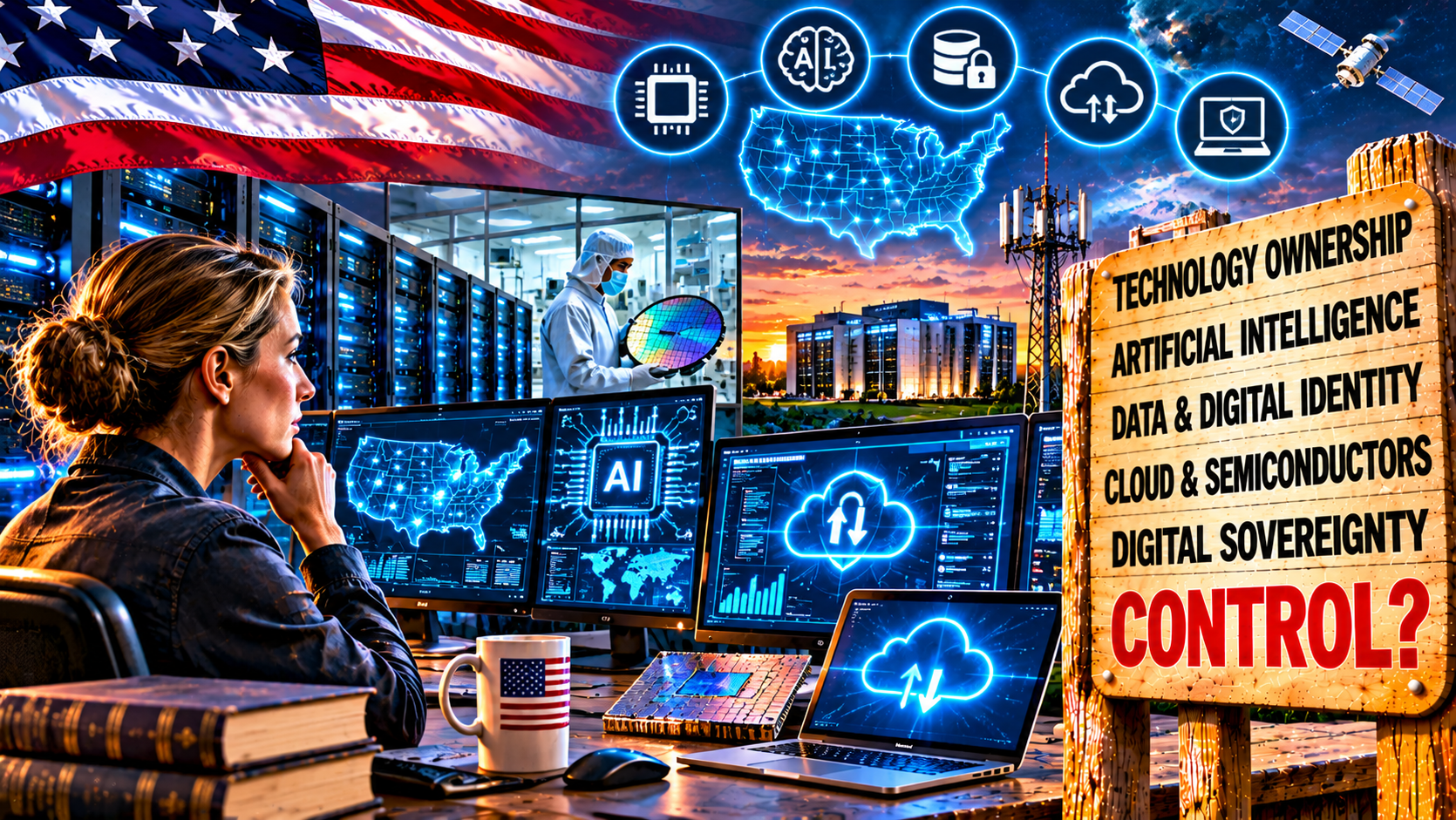
EVIDENCE 017 | NATIONAL CRITICAL INFRASTRUCTURE INVESTIGATION
AMERICA'S
TECHNOLOGY &
DIGITAL SOVEREIGNTY
FORENSIC AUDIT: Who Controls the Technology America Depends Upon?
Investigate AI, cloud concentration, semiconductor supply chains, digital identity and operational independence.
OPEN THE INVESTIGATION COMMAND CENTEROWNERSHIP & GOVERNANCE
AUTOMATION
& DIGITAL ID
SEMICONDUCTORS
& RESILIENCE
01 | Documented Technology Disruptions
What Happens When a Shared Technology Fails?
Reconstruct actual incidents before drawing conclusions about concentration, accountability or intent.
July 2024 CrowdStrike Outage
A defective Falcon content update affected Windows systems worldwide, disrupting aviation, healthcare and other services. It was not established as a cyberattack. Examine the vendor's published root-cause analysis, validation controls and customer recovery procedures.
2020 SolarWinds Supply-Chain Compromise
Attackers compromised SolarWinds Orion software distribution and used the trusted update channel in a sophisticated intrusion campaign. Distinguish the supply-chain compromise from the different impact at each affected organization.
2021 Major Cloud Service Disruptions
Public cloud outages, including AWS us-east-1 disruptions, demonstrated how dependencies on regional cloud services can affect unrelated customer applications. Verify provider post-incident reports for the specific event and impact.
Concentration and Recovery
Identify single-provider identity, DNS, CDN, cloud, security-agent and software-update dependencies. A high market share alone does not prove an intentional shutdown capability or a common failure mechanism.
02 | Historical Technology Milestones
How Did Digital Dependence Develop?
A technology timeline must distinguish statutory changes, industry adoption and operational consequences.
1970s–1990s: Personal Computing and Networks
Computers and local networks expanded independent organizational capability while introducing new software, hardware and security dependencies.
1990s–2000s: Commercial Internet and Outsourcing
Internet connectivity, enterprise software and managed services widened interoperability and created new third-party risk.
2000s–2010s: Cloud and Mobile Platforms
Cloud infrastructure, smartphones and centralized identity made rapid scaling possible while concentrating some critical functions.
2020s: AI, Chips and Software Supply Chains
AI adoption, advanced semiconductors and large-scale software dependencies raise questions about provenance, safety, resilience, competition and oversight.
03 | Ownership, Authority and Decision Rights
Who Can Make a System Unavailable?
Map ownership, contractual rights, legal authority and technical permissions separately.
Cloud and Software Providers
Own or operate platforms, control product updates and availability terms, and may hold significant operational privileges under customer contracts.
Customers and Data Controllers
Choose architectures, data handling, access policies, backups, retention and vendor terms within applicable law; responsibilities may be shared.
Government and Regulators
Apply sector-specific laws and procurement rules. FTC, DOJ, NIST, CISA and sector regulators have different roles; no single body controls all U.S. technology.
Open Standards and Intellectual Property
Assess licensing, interoperability, source-code escrow, export controls, patents, portability and the feasibility of substituting a provider.
04 | Technology Dependencies and Cascades
Where Are the Single Points of Failure?
A shared component can become a common-mode failure across multiple otherwise independent organizations.
Semiconductor Fabrication
Assess foundry concentration, specialized equipment, packaging, materials, design tools and lead times. Use verified supply-chain data, not assumptions about a supplier's nationality.
Cloud, DNS and Identity
Map regions, authentication, certificate authorities, domain services, network transit, control planes and backup recovery dependencies.
Data Portability and Vendor Lock-In
Examine export formats, APIs, data egress, proprietary integrations, cryptographic key custody and the cost and time to migrate.
Critical-Industry Digital Links
Evaluate how hospitals, utilities, transportation, government and small businesses depend on shared software and cloud infrastructure.
05 | AI, Digital Identity and Cybersecurity
Can Systems Remain Secure and Recoverable?
Cybersecurity and digital sovereignty require more than geographic data residency.
Zero Trust and Least Privilege
Use identity verification, scoped permissions, network segmentation, device posture and monitored privileged access. Maintain emergency access that is tested and audited.
AI Governance and Human Oversight
Inventory AI use, classify data sensitivity, test outputs, maintain human approval for consequential actions and evaluate model/vendor change management using NIST AI RMF.
Software Supply-Chain Integrity
Require signed releases, reproducible evidence where feasible, staged deployments, SBOM visibility, vulnerability handling and tested rollback procedures.
Privacy, Identity and Surveillance Risk
Distinguish documented data collection from speculative monitoring claims. Review lawful basis, retention, disclosure, consent, access logs and independent oversight.
06 | SWOT / TOWS Assessment
Where Can America Strengthen Digital Independence?
Translate verified strengths and vulnerabilities into actionable responses.
Strengths
Advanced research, a large software ecosystem, domestic innovation, open standards, security expertise and substantial computing capacity.
Weaknesses to Test
Vendor concentration, legacy systems, limited visibility into subcontractors, inadequate recovery exercises, proprietary formats and untested backups.
Opportunities
Interoperability, secure-by-design procurement, regional semiconductor capacity, workforce training, open-source scrutiny and multi-provider recovery.
Threats and TOWS Responses
Supply shocks, cyber intrusions, defective updates, outages and coercive vendor terms. Diversify critical functions, isolate failure domains and practice restoration.
07 | Corrective Measures and Prevention
Rebuild Control Through Evidence and Engineering
Assign accountable owners, budgets and measurable milestones.
Households and Individuals
Use phishing-resistant MFA where available, protect recovery codes, maintain offline copies of essential records, review app permissions and test account recovery.
Small and Medium Businesses
Inventory SaaS and identity dependencies, establish independent backups, document manual workarounds, verify contractual data export and test vendor outage playbooks.
Critical Infrastructure Operators
Apply CISA cross-sector goals, maintain OT/IT segmentation, test update rings, preserve offline restoration capability and exercise supplier failure scenarios.
Public Policy and Procurement
Promote transparent outage reporting, competitive procurement, interoperability, independent assurance and proportionate privacy safeguards consistent with applicable law.
08 | Primary-Source Evidence Register
Follow the Evidence, Not Assumptions
These are official investigation and framework entry points. Confirm each incident-specific publication, affected versions and dates before using quantitative claims.
INVESTIGATE. VERIFY. CORRECT. REBUILD.
Evidence 017 | America's Technology, Artificial Intelligence & Digital Sovereignty — FORENSIC AUDIT
RETURN TO FORENSIC AUDIT COMMAND CENTER