
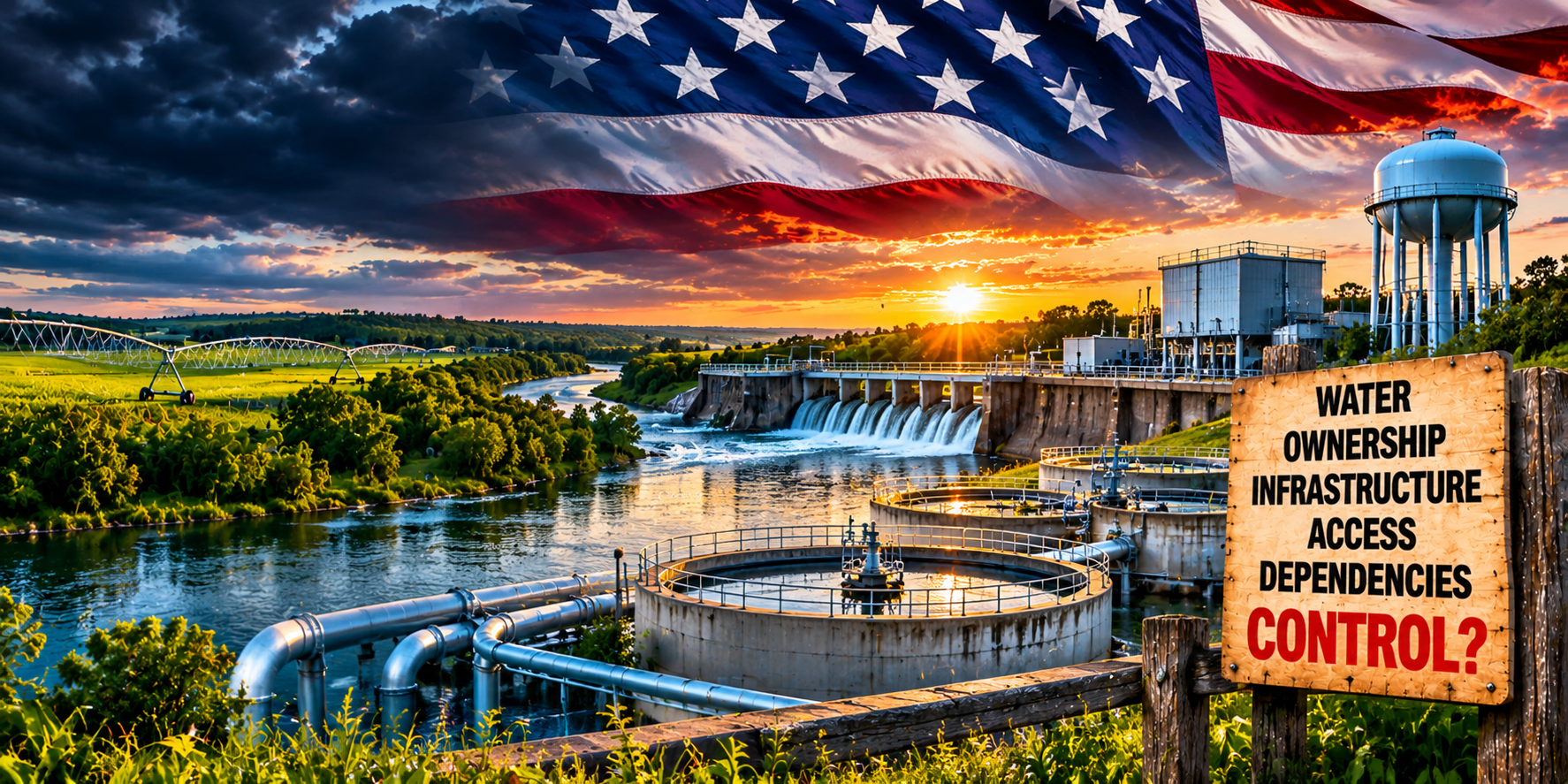
Evidence 004 | National Infrastructure Investigation
AMERICA'S
WATER SECURITY
FORENSIC AUDIT
Who Controls Our Water — and How Secure Is the Infrastructure That Delivers It?
Follow the evidence from water rights and reservoirs to treatment facilities, digital control systems, agricultural irrigation and household access. Investigate documented failures, concentrated dependencies and the path to resilient water infrastructure.
OPEN THE INVESTIGATION COMMAND CENTER& ACCESS
INFRASTRUCTURE
& QUALITY
CONTROL SYSTEMS
RESILIENCE
01 | Open Investigation
What Happens When Water Infrastructure Fails?
A community can have an abundant natural water source and still lose safe, reliable water service when treatment, pumping, electricity, operational controls, distribution or public governance fail. This FORENSIC AUDIT examines documented events and tests how local failures could cascade into agriculture, healthcare, business and public safety.
Flint, Michigan — Drinking Water Crisis
Following a 2014 water-source change, corrosion-control failures contributed to lead contamination. The investigation must distinguish the water chemistry, regulatory decisions, monitoring and public-health consequences using official records.
Oldsmar, Florida — 2021
Officials reported unauthorized remote access to a water-treatment control interface and an attempted change to a chemical setpoint. The change was detected and reversed; reported intent and attribution require separate evidentiary treatment.
02 | Historical Evidence Reconstruction
Water Policy, Infrastructure and Security: Key Turning Points
Open each record to examine the milestone and the questions it raises. These entries are starting points for deeper quantitative investigation, not proof of a single overarching cause.
1972Clean Water Act Amendments
Federal water-pollution control law established a major framework for regulating pollutant discharges into waters of the United States.
Investigate: Changes in discharge monitoring, wastewater infrastructure, enforcement, and measurable water quality.
EPA — Clean Water Act summary1974Safe Drinking Water Act
The Safe Drinking Water Act established the federal framework for protecting public drinking-water supplies, with subsequent amendments expanding requirements and programs.
Investigate: Compliance capacity, small-system financing, treatment standards, monitoring and emergency readiness.
EPA — Safe Drinking Water Act1996Drinking Water Law Amendments
Congress amended the Safe Drinking Water Act, strengthening provisions involving risk-based standards, public information, and state drinking-water programs.
Investigate: Consumer confidence reports, source-water assessments, infrastructure funding and implementation outcomes.
EPA — SDWA overview2014Flint Water Crisis and Corrosion Control
Flint's water-source change and subsequent failures in corrosion-control practices became a major drinking-water public-health and governance crisis.
Investigate: Decision authority, technical warnings, regulatory oversight, lead sampling, response time and accountability.
EPA — Flint drinking-water response2021Oldsmar Water-Treatment Cyber Incident
Public authorities described an attempted unauthorized adjustment of a treatment chemical setpoint through remote access. Review primary incident reporting carefully; some later interpretations of attribution and intrusion mechanism have been disputed.
Investigate: Remote-access exposure, operator verification, alarms, safety interlocks, segmentation and incident reporting.
CISA — Water and Wastewater Systems resources2023–24Warnings About Exposed Water-Sector Control Systems
Federal agencies issued warnings about cyber activity targeting water and wastewater systems, including internet-exposed operational technology. Distinguish confirmed compromises from general alerts and potential exposure.
Investigate: Default credentials, internet exposure, patching, asset inventories, incident response and secure remote access.
CISA — Water sector cybersecurity guidance03 | Ownership, Rights and Public Access
Who Controls Water — and Under Which Laws?
Water access is governed by overlapping federal, state, tribal, local and private rights. Ownership of land, rights to withdraw water, ownership of a utility and control of distribution infrastructure are different legal and operational questions.
Surface Water
Examine state allocation doctrines, permits, interstate compacts, tribal rights, reservoir operations and drought restrictions. Rules vary substantially by jurisdiction.
Groundwater
Investigate aquifer conditions, withdrawal rights, local groundwater districts, monitoring, recharge, agricultural demand and the effects of long-term depletion.
Municipal and Private Utilities
Distinguish public, investor-owned, cooperative and other service models. Assess rate setting, accountability, emergency powers and capital investment.
Household and Agricultural Access
Examine service affordability, rural wells, irrigation rights, water quality, local restrictions and lawful options for resilience in each state.
04 | Infrastructure Dependency Mapping
From Source Water to the American Household
Water security depends on an interconnected chain of physical, chemical, digital and human systems. The failure of a critical component can interrupt service even when the source water remains available.
Physical Single Points of Failure
Evaluate sole-source intakes, pumping capacity, electrical feeders, chemical supply, aging pipes, treatment bottlenecks and backup-generation limitations.
Interconnected Dependencies
Map water reliance across hospitals, firefighting, agriculture, food processing, energy generation, semiconductor manufacturing and local commerce.
05 | Cybersecurity and Operational Technology
Can Connected Water Systems Be Safely Operated During an Attack?
Industrial control systems, remote access, telemetry, billing, dispatch and monitoring are operational assets. Cybersecurity must protect both digital integrity and physical treatment safety.
Reduce Exposed Attack Paths
Inventory assets, remove unnecessary internet exposure, eliminate default passwords, enforce strong authentication and tightly control vendor remote access.
Verify Process Integrity
Monitor abnormal setpoints and access events, correlate process alarms with physical measurements, and train operators to challenge unexpected changes.
Maintain Safe Operations
Test manual operating procedures, independent safety limits, network segmentation, communications fallback and essential spare-parts availability.
Restore Verified Service
Practice incident response, retain protected configuration backups, verify water quality before normal service, and coordinate public communications.
06 | Strategic Forensic Analysis
SWOT Analysis + TOWS Corrective Strategy
SWOT — IDENTIFY
- Strengths: Established treatment expertise, public-health monitoring, local operators and existing regulatory frameworks.
- Weaknesses to test: Aging assets, fragmented oversight, limited staffing, sole-source dependencies and exposed operational technology.
- Opportunities: Regional mutual aid, infrastructure renewal, better leak detection, safe reuse and resilient local supply.
- Threats: Contamination, drought, flood, power outages, cyber intrusion and treatment-chemical shortages.
TOWS — CORRECT
- Strengths + Opportunities: Use existing operator knowledge and monitoring programs to prioritize measurable modernization.
- Weaknesses + Opportunities: Reduce single points of failure through targeted investment and mutual-aid agreements.
- Strengths + Threats: Pair regulatory testing with physical redundancy, cybersecurity drills and transparent public alerts.
- Weaknesses + Threats: Prioritize utilities with verified high-consequence exposures and inadequate recovery capability.
07 | Corrective Action and Prevention
Rebuilding Water Security From the Household to the Nation
Know the Local Water Risk
Review utility water-quality reports and emergency notices, identify appropriate backup water options, and understand well-testing requirements where applicable.
Plan for Service Interruption
Coordinate emergency water distribution, mutual aid, accessible public alerts and continuity support for vulnerable residents.
Engineer Measurable Resilience
Map critical dependencies, test backup power and fuel, secure OT access, maintain treatment supplies, rehearse recovery and measure restoration time.
Demand Verifiable Accountability
Evaluate infrastructure investment, rate transparency, regulatory performance, watershed protection and lawful reforms using documented outcomes.
08 | Evidence Register
Primary Sources and Investigation Records
The links below establish regulatory frameworks, documented response activity and authoritative sector guidance. Further incident-specific records and time-series data are required before assigning comprehensive root causes or quantified risk.
Review federal statutory framework
Review drinking-water regulation
Review Flint investigation and response materials
Review cybersecurity and operational resilience guidance
Review hydrology and water resource science
Review infrastructure-needs assessment program
INVESTIGATE. VERIFY. CORRECT. REBUILD.
Evidence 004 | America's Water Security — FORENSIC AUDIT
RETURN TO FORENSIC AUDIT COMMAND CENTER