EVIDENCE 016 | NATIONAL CRITICAL INFRASTRUCTURE INVESTIGATION
AMERICA'S
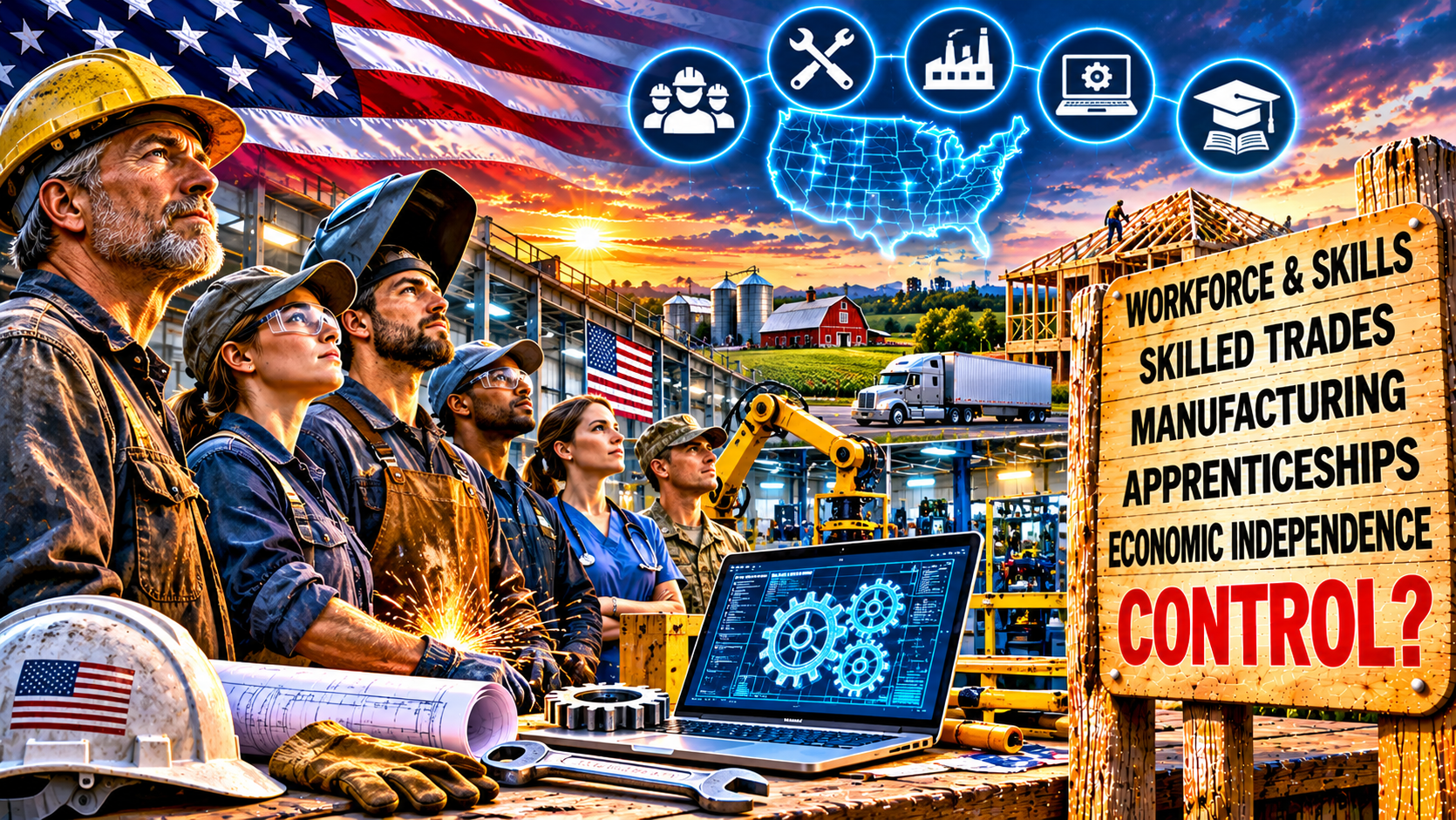
WORKFORCE &
SKILLED TRADES
FORENSIC AUDIT: Can America Sustain the Workforce Its Essential Systems Require?
Trace skills, apprenticeships, manufacturing capacity, automation and the pathways to economic independence.
OPEN THE INVESTIGATION COMMAND CENTER& SKILLS
& APPRENTICESHIPS
MANUFACTURING
& DIGITAL SECURITY
& RESILIENCE
01 | Documented Workforce Disruptions
What Happens When Essential Skills Are Unavailable?
A workforce shortage is not established by job postings alone. Investigate vacancies alongside wages, location, credentials, training capacity, productivity and working conditions.
2021 Colonial Pipeline Shutdown
A ransomware incident led Colonial Pipeline to halt pipeline operations temporarily. The case demonstrates how cyber incidents can interrupt the work of highly specialized operators and the downstream fuel system; it does not prove a general labor shortage.
2024 Change Healthcare Cyberattack
A cyberattack disrupted healthcare claims and payment processing, showing that critical-service continuity depends on trained personnel, secure technology and vendor alternatives as well as physical assets.
Replacement of Retiring Workers
Use Bureau of Labor Statistics occupation-level employment projections, age profiles and replacement openings to test which skills face succession pressure. Avoid treating every retirement as an unfilled job.
Domestic Production and Repair
Map the people and facilities required to fabricate, install, inspect, maintain and restore transformers, water equipment, homes, industrial controls and other essential assets.
02 | Historical Decisions and Changes
How Did America's Workforce System Evolve?
Trace laws, economic transitions and technology adoption without assuming that any single event explains today's workforce outcomes.
1937 National Apprenticeship Act
1960s–80s Industrial Restructuring
1994 NAFTA Takes Effect
2000s Digitalization and Global Supply Chains
2020–22 Pandemic Labor and Supply Disruptions
2022 CHIPS and Science Act
2023–26 AI and Industrial Automation
03 | Decision Rights, Training and Accountability
Who Determines Which Skills America Develops?
Employers, workers, schools, states, unions, credentialing bodies and federal agencies have distinct authorities. There is no single national workforce controller.
Employers and Procurement
Set hiring requirements, wages, job design, vendor qualifications and training budgets. Audit whether experience requirements, hiring processes or compensation constrain applicant pools.
States, Community Colleges and Schools
Control major elements of vocational education, licensing and training delivery. Map program capacity, waitlists, equipment, instructors and employer partnerships by region.
Federal Workforce Programs
The Department of Labor supports registered apprenticeships and workforce programs; the Workforce Innovation and Opportunity Act establishes important state and local structures. Verify actual eligibility and outcomes.
Licensing, Safety and Worker Protections
Professional licensing and safety rules can protect the public but also affect labor mobility and entry. Review the exact jurisdiction, statutory basis, reciprocity rules and appeals before proposing reform.
04 | Essential Skills and Cascade Pathways
Which Workforce Dependencies Can Interrupt Critical Services?
Critical infrastructure resilience requires enough qualified people to operate, repair and restore essential assets under stress.
Energy and Water
Electricians, lineworkers, treatment operators, instrumentation technicians and industrial-control specialists are essential to safe operations and restoration.
Housing and Construction
Carpenters, plumbers, HVAC technicians, inspectors and engineers affect construction throughput, safe retrofits and disaster recovery.
Manufacturing and Logistics
Machinists, welders, tool-and-die specialists, mechanics, drivers and supply-chain coordinators sustain production and delivery.
Digital and Security Operations
Network engineers, software maintainers, OT security teams and incident responders protect the systems on which physical operations increasingly depend.
05 | Workforce Cybersecurity and Automation
Can Technology Expand Capacity Without Creating Fragile Dependencies?
Digital tools can improve productivity while creating vendor, access-control, data-integrity and operational-technology risks.
Industrial Control Systems
Segment operational networks, restrict remote access, use multifactor authentication where technically feasible and maintain safe local operating procedures. Apply CISA and NIST guidance appropriate to the environment.
Vendor and Contractor Access
Limit privileged access, record changes, review subcontractors and revoke credentials promptly when assignments end. Test recovery from a vendor outage.
AI-Assisted Work
Protect confidential plans, source code and worker records. Require human review for safety-critical decisions, verify generated instructions and document accountability.
Training and Succession Records
Preserve equipment documentation, skills matrices, secure backups and cross-training. Avoid having only one employee or supplier who knows how to restore a critical system.
06 | SWOT / TOWS
Where Can America Rebuild Productive Capability?
Evaluate strengths and vulnerabilities by industry and region rather than using a single national narrative.
Strengths
Established technical colleges, apprenticeship programs, innovative employers, research institutions, experienced tradespeople and diverse regional industrial clusters.
Weaknesses to Test
Unfilled critical roles, training bottlenecks, outdated equipment, narrow credential pathways, insufficient knowledge transfer and reliance on a small pool of specialists.
Opportunities
Paid apprenticeships, veteran-to-trade pathways, community-college partnerships, employer-led upskilling, domestic repair capacity and secure productivity tools.
Threats and TOWS Responses
Cyber outages, supply shocks, demographic transitions and regional mismatches. Cross-train staff, diversify suppliers, preserve manual skills and validate emergency staffing plans.
07 | Corrective Measures and Prevention
Build Skills, Reduce Single Points of Failure and Restore Capability
Each proposed action should have a responsible owner, baseline, funding pathway, legal review and measurable outcome.
Households and Workers
Compare accredited and registered programs, actual completion rates, total costs, wages and regional demand. Explore apprenticeships, community-college certificates and portable credentials.
Small Businesses
Document critical job knowledge, create succession plans, train backups, protect intellectual property, establish secure contractor access and develop continuity plans.
Schools and Workforce Boards
Publish transparent outcomes, align equipment and curricula with local employer needs, support work-based learning and reduce avoidable barriers to entry.
Critical Infrastructure Operators
Inventory scarce skills, map supplier and contractor concentration, conduct cyber/physical exercises, and test mutual aid and emergency restoration capacity.
08 | Primary-Source Evidence Register
Verify Workforce Claims with Official Data
These are research entry points. Verify the specific table, date, geography, definition and methodology before publishing numerical claims.
INVESTIGATE. VERIFY. CORRECT. REBUILD.
Evidence 016 | America's Workforce, Skilled Trades & Economic Independence — FORENSIC AUDIT
RETURN TO FORENSIC AUDIT COMMAND CENTER