2003 — Northeast blackout
A major outage propagated across interconnected U.S. and Canadian power systems. The official joint task force examined reliability practices, vegetation management, operator awareness and failure propagation.
EVIDENCE 001 | THE FOUNDATIONS
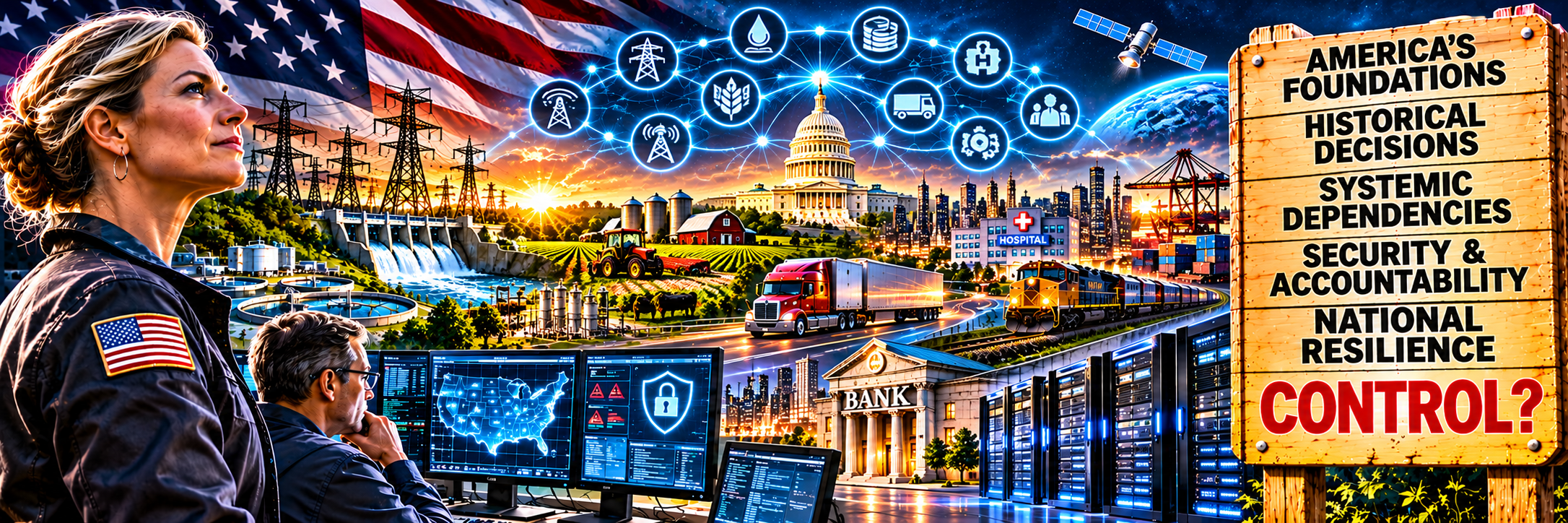
FORENSIC AUDIT: How Did America's Essential Systems Become So Interdependent?
Investigate documented failures, historical decisions, shared dependencies, accountability and the practical work of rebuilding resilience.
OPEN THE INVESTIGATIONCOMMAND CENTER01 | FOUNDATIONAL FORENSIC AUDIT
Begin with what happened—not an assumption about motive. These events show why shared dependencies and recovery capability must be investigated.
A major outage propagated across interconnected U.S. and Canadian power systems. The official joint task force examined reliability practices, vegetation management, operator awareness and failure propagation.
Extreme cold contributed to widespread power-generation and fuel-system failures, affecting water supply, healthcare and daily life. FERC and NERC examined cold-weather preparedness and infrastructure interdependence.
A ransomware incident affecting business systems prompted a precautionary pipeline shutdown, illustrating how cyber disruption and operational decisions can affect physical fuel distribution.
A defective software content update disrupted Windows systems across multiple sectors. The initiating cause was a software defect, not a demonstrated hostile cyberattack.
A cyberattack on a major healthcare transaction provider interrupted claims and payment-related services, exposing reliance on a concentrated intermediary.
02 | FOUNDATIONAL FORENSIC AUDIT
National resilience rests on essential services, productive capacity, accountable institutions and communities able to function during disruption.
Electricity, fuel, water, wastewater, transportation, communications, healthcare, finance and emergency services form interconnected operating systems.
Agriculture, manufacturing, skilled trades, domestic supply chains, warehousing and logistics sustain essential goods and repair capability.
Households, small businesses, schools, local governments, utilities, regulators and emergency responders each hold different responsibilities and capabilities.
Identity, telecommunications, cloud services, software updates, industrial controls and data integrity increasingly influence continuity across otherwise separate industries.
03 | FOUNDATIONAL FORENSIC AUDIT
Investigate specific decisions and measurable outcomes rather than treating every historical change as harmful or intentional.
Assess mergers, consolidation of suppliers, regional processing capacity and economies of scale against measurable effects on redundancy, prices, competition and recovery.
Trace offshoring, just-in-time inventory, critical imports and specialized manufacturing. Identify both efficiency gains and exposure to supply disruption.
Examine migration to networked operations, cloud hosting, automated controls and managed software. Determine whether independent fallback options were retained.
Review enacted laws, agency rules, procurement decisions, infrastructure investment, maintenance deferrals and public-private responsibilities with dated source records.
04 | FOUNDATIONAL FORENSIC AUDIT
A shared supplier or service can create common-mode exposure; a cascade must be demonstrated, not assumed.
Power supports pumps, treatment, refrigeration and clinical care. Backup power, fuel availability and tested operating procedures determine how long essential functions can continue.
Networks, authentication and timing support transactions, dispatch and coordination. Outages may affect payments, inventory and service access.
Roads, rail, pipelines, ports and fuel supplies support farm production, grocery delivery, medicines and emergency operations.
A single software provider, identity service or update channel may affect many otherwise independent organizations simultaneously.
05 | FOUNDATIONAL FORENSIC AUDIT
Ownership, regulation and operational authority vary by sector and jurisdiction. The audit must identify the actual responsible parties.
Record the legal owner, day-to-day operator, major vendors and subcontractors for each critical asset or service.
Identify the applicable federal, state, tribal or local regulators and their specific statutory responsibilities—without assuming one agency controls everything.
Assess access rights, industrial-control boundaries, change approval, incident escalation, logging and authority to initiate shutdown or restoration.
Examine publicly documented incident reviews, audits, contracts, enforcement actions and corrective-action status. Distinguish proven misconduct from unanswered questions.
06 | FOUNDATIONAL FORENSIC AUDIT
The 24 investigations share a disciplined method: establish facts, test explanations, reconstruct consequences and specify practical corrections.
Use primary-source reports, original incident statements, regulatory filings, official data and contemporaneous operational records. Cite dates and versions.
Clearly identify reasoned interpretation, causal inference, limitations, confidence level and plausible competing explanations.
Identify missing records, conflicting statements, uncertain responsibility and the evidence needed to resolve each issue.
Model plausible future cascading failures separately from documented incidents. Specify assumptions, exposure and possible mitigations.
Assign a responsible actor, priority, measurable control, validation test and review date. Evaluate lawful, technically feasible alternatives.
07 | FOUNDATIONAL FORENSIC AUDIT
SWOT describes internal and external conditions. TOWS converts those conditions into actionable strategies.
Engineering expertise, diverse regional capabilities, public safety institutions, established infrastructure, innovation and community networks.
Aging assets, concentrated providers, limited local alternatives, inconsistent dependency inventories and untested restoration plans.
Regional production, domestic repair capability, supplier diversification, microgrids, secure modernization and cross-sector exercises.
Cyber incidents, natural hazards, software defects, supply interruptions, equipment failures and simultaneous disruption of shared providers.
08 | FOUNDATIONAL FORENSIC AUDIT
The goal is not to abandon interconnection. It is to preserve its benefits while restoring options, accountability and recoverability.
Prepare realistic water, food, medicine, communications and backup-power plans. Coordinate safely with neighbors and local emergency guidance.
Inventory critical systems and suppliers; protect identities and backups; establish offline operating procedures and test restoration and payment alternatives.
Prioritize asset inventories, OT/IT segmentation, vendor assurance, alternate sources, manual safe states, staged updates and cross-sector recovery exercises.
Review local production capacity, emergency mutual aid, lawful procurement reforms, regional infrastructure investment and transparent public reporting.
09 | VERIFICATION REGISTER
These official resources establish starting points. Verify each specific report and incident record before relying on a numerical or causal claim.
Twenty-four interconnected investigations. One mission: establish the evidence, trace the dependencies, strengthen accountability and prevent avoidable systemic failures.
RETURN TO THE FORENSIC AUDIT COMMAND CENTERNEXT: EVIDENCE 002 — AMERICA'S FOOD SYSTEM